
Category: Issue 05
RECLAMATION PROJECT (trash vault)
In the instant after the Chevron refinery explodes, I descend below the level of individual syllables.
Sky, through my kitchen window, a trash vault.
Punctuation without words is a primary red, then, between smoke-bursts, florid.
Everyone on the block, out on the sidewalk to watch.
Smoke unfastens its vowels from the orderly control of our consonants.
My neighbor is experiencing shortness of breath, my lungs have acquired a vanishing point I
do not test.
Conversation romances its calamities, modifies for us a commons.
We mime humanity for the already-overhead TV helicopter.
My neighbor seems to be developing a thingness in his eyes.
We are already, to each other, TV noise, a regulating background.
Theatrical value-add of windows in the houses around us sliding shut.
We all know to go back inside, as though summoned.
Event already franchised—event-technology already busily procuring event-disposal.
*
Rusty Morrison‘s –Beyond the Chainlink- (Ahsahta) will be published in January 2014. Her book -After Urgency- won Tupelo’s Dorset Prize. -Book of the Given–is available from Noemi Press. -the true keeps calm biding its story- won Ahsahta’s Sawtooth Prize, Academy of American Poet’s James Laughlin Award, Northern California Book Award, and DiCastagnola Award from Poetry Society of America. –Whethering-won the Colorado Prize for Poetry. She has received the Bogin, Hemley, Winner, and DiCastagnola Awards from PSA. Her poems and/or essays have appeared in A Pubic Space, American Poetry Review, Aufgabe, Boston Review, Kenyon Review, Lana Turner, Pleiades, and elsewhere. Her poems were anthologized in the Norton Postmodern American Poetry 2nd Edition, The Arcadia Project: Postmodern Pastoral, Beauty is a Verb, and elsewhere. She is co-publisher of Omnidawn.
Frederick Douglass Presenting His Narrative
Vacillating between
: a sublimate; an occupant
who collects identity through distance.
First, I learned how
to read, then
how to write.
Remember the ramifications
of neglecting the ex post facto
—in assuming judgment
Homonyms—lone and loan
there, they’re, their—registering
precedent times
for my ever child while
Those miniature tea sets I displayed
at the top of my father’s stairs
like unwritten agreements
, trying to catch explanations for themselves
should anyone ask.
An hour of talk
on the subject of who
and how you exist.
Tales of familiarity are borrowable, even
ownable and impactful equally
as they are reprehensible.
I like podiums
as much as the next person.
But, for someone you adore,
it’s a pleasure to be sad.
Today is the pronunciation
of my name.
*
Annie Goold is an Illinois native and undergraduate at University of Illinois-Chicago where her poetic convictions first grew teeth. She has since found poetic growth, community, and sublimity under the instruction of Lina ramona Vitkauskas, Francesco Levato, and Eileen Myles along with numerous dazzling classmates through the Chicago School of Poetics. With crossed fingers and booming efforts, she intends to enter a graduate program for poetry in fall of 2014. In the meantime, she soaks in the expanding vocabulary of her dog, excellent companionship, and the art of city biking.
Queen Elizabeth I on First Addressing the House of Lords
It’s a gripping seat
here made
of glue-stiffened lace.
Have these shoulders been
let down in a decade?
Do they know another
weight than expectation?
Snake muscles—
pulsing at hold
Clearly, my face wasn’t
supposed to shine here.
The first words
for bridging diplomacy
are to be shed
in the homeland.
Trouble whelming
Think fast—
smoke has begun.
Can a time-marker occupy
more than abhorrence
for those wanting only sleep?
This is no time for
anything but iron foresight.
A ground for saber-faced horses
big cats, purple and white
Breathe into the mirror,
name your timber.
Primp the ivory lioness mane.
Choices, choices:
Required
and met.
*
Annie Goold is an Illinois native and undergraduate at University of Illinois-Chicago where her poetic convictions first grew teeth. She has since found poetic growth, community, and sublimity under the instruction of Lina ramona Vitkauskas, Francesco Levato, and Eileen Myles along with numerous dazzling classmates through the Chicago School of Poetics. With crossed fingers and booming efforts, she intends to enter a graduate program for poetry in fall of 2014. In the meantime, she soaks in the expanding vocabulary of her dog, excellent companionship, and the art of city biking.
Another Satisfied Customer
We phoned. Quite analytically we
dissected its molecular structure.
And how it made Grandma Liu
all woozy when she woke.
It conflicted with her porridge,
made her bridge chatter, even if
her gums were doing most
of the work. And you know what
they said? They said it had something
to do with politics. The etiquette of
the matter. Yes, it struck a chord
in the hearts of us all. They were
uncomfortable to say the least.
But what could they do? It was
only a job, after all. You couldn’t
blame them for something that wasn’t
of their own making. Just a soldier
they said, taking orders from the
head office. Would you believe it?
We’d a right mind to write to
our local Party secretary. But then,
we decided against it and drew
Grandma Liu’s morning bath with
that oil that makes her smell of roses.
* * *
Marc Vincenz is Swiss-British, was born in Hong Kong, and currently divides his time between Reykjavik, Zurich and New York City. His work has appeared in many journals, including Washington Square Review, Fourteen Hills, The Potomac, The Canary, The Bitter Oleander, and Guernica. Recent publications include: The Propaganda Factory, or Speaking of Trees (2011); Gods of a Ransacked Century (2013), Mao’s Mole (Neopoiesis Press, 2013) and the forthcoming meta-novel, Behind the Wall at the Sugar Works (Spuyten Duyvil, 2104). His most recent collection of translations is Nightshift / An Area of Shadows by Erika Burkart and Ernst Halter (Spuyten Duyvil, 2013). Marc is Executive Editor of Mad Hatters’ Review, MadHat Press and Coeditor-in-Chief of Fulcrum: An Annual of Poetry and Aesthetic.
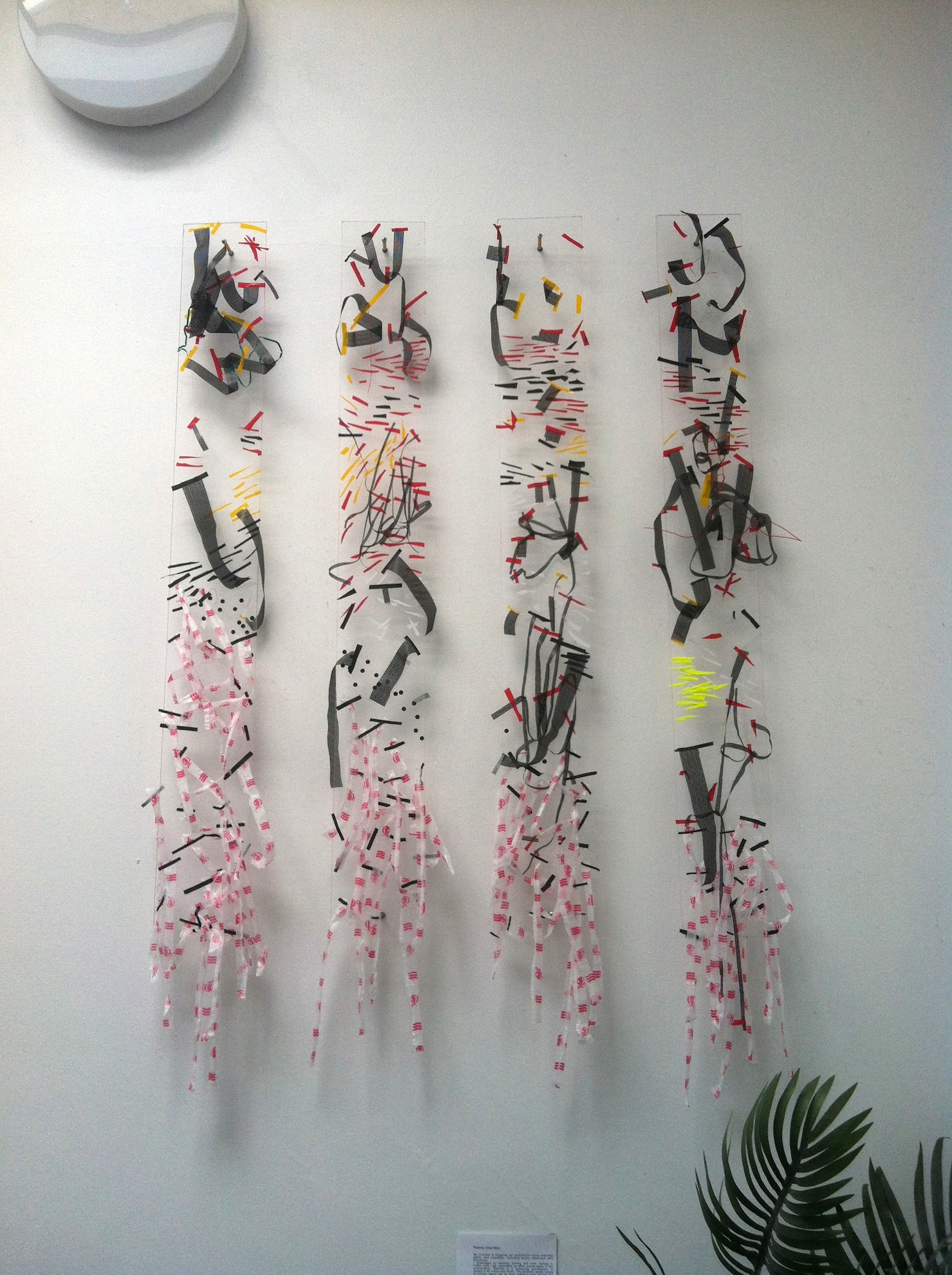
Words Beyond
*
(Words Beyond, 60 x 48, plexi-glass panels, vinyl tape, 2013)
Reenie Charrière – Artist website
Artist statement:
“I am invested in everyday moments. My practice is triggered by expeditions along everyday paths, and sidewalks, including public waterways and shorelines.
I investigate by walking, driving and even waiting in traffic, and I am captivated by what accumulates in the environment. Detritus is a menacing punctuation. It comes in all colors and forms. The synthetic bright colors of plastic haunt me as they interrupt and accent the natural topography. I am also drawn to these colors, and their forms as well as the juxtaposition between organic and synthetic matter.
My current work starts with photographing this relationship. Going beyond documentation, I spotlight the situation by fabricating sculptural installations out of discarded packaging materials, particularly plastic, fabric, paper, and cardboard. By sewing, cutting, fusing, reshaping, dangling, and weaving, I transform the material into atmospheric and surprisingly organic-like structures. Many of my installations are integrated with video, projections, and or sound. My choice of materials reflects a collision of clumsiness, and grace and questions how consumerism drives the world.”
Record
Never been this hot, never rained so much, so
hard, never been this cold, never shoveled this
much, never seen so many mosquitoes, never hit
so many runs, never had so many drop-out, never
sold so many slushees, tacos, hot dogs, ice cream
bars, never seen so many overweight, underweight;
never tried so hard, worked so hard, missed so many
days, never ate so much, never had so much fun,
so many disappointments, so many mistakes.
Never wore it, never had an occasion to go,
never washed it again, never seen so much mold,
rotting, growth, so many cavities, so many tumors,
so much potential. Never loved, hated, envied, wanted,
wished, so much, so much. Never had one of my own.
Never finished it, never quite made it, never made it
back there, never saw her again. Never felt so tired.
Never want to go there, see you, feel that way, never,
never saw so many bodies, never felt so hungry,
never been so afraid, never saw so much blood,
never forgot. Never want to forget. Never did.
*
Rebecca Morgan Frank is the author of the poetry collection Little Murders Everywhere (Salmon, 2012), a finalist for the Kate Tufts Discovery Award, and her poems have appeared in Guernica, The Missouri Review, Ploughshares, Crazyhorse, and elsewhere. She is the co-founder and editor-in-chief of the online magazine Memorious and an assistant professor at the University of Southern Mississippi.
Notes on the National Body
The flesh of the body is the nation.
Nations build bodies, build boundaries.
The flesh of the body is the nation.
The nation is betrayed by the flesh
of the body. The nation says this
is the national body. The bodies outside
the boundaries are not the national
bodies nor are the bodies on the boundaries
of nations. The flesh of the body is the marker.
Enclose the foreign bodies. The bodies
made foreign by your enclosure. This
is the flesh, this foreign body.
You may not claim a nation. A nation
claims you based on the body: thus I am of this nation,
my grandfather, not of this body of a nation.
Nor the body of his nation born, his body
the hybrid body. Ejected by nation and nation.
The liminal body. Escapes the boundaries
by water, the fluid body. Bounded by nations.
The flesh of the body is the nation.
The nation is the body made flesh.
*
Rebecca Morgan Frank is the author of the poetry collection Little Murders Everywhere (Salmon, 2012), a finalist for the Kate Tufts Discovery Award, and her poems have appeared in Guernica, The Missouri Review, Ploughshares, Crazyhorse, and elsewhere. She is the co-founder and editor-in-chief of the online magazine Memorious and an assistant professor at the University of Southern Mississippi.
We The People
The body is not as wrapped.
Wooden, the flowers snap
at the neck. I dug deep in
to the jungle soil to place your
bones. To find them. Even
ceremony is forbidden.
The bodies by the sides–
if we buried them one
by one it would fill the forest.
Before the heat has taken
hold. Too soon. Cold blooded.
The throat slit. The virgin throat
swallowing watches its own
hand. The hand that washes
the rice. The hand that lifts
it to the mouth and reaches
for the other in sleep. In waking.
*
Rebecca Morgan Frank is the author of the poetry collection Little Murders Everywhere (Salmon, 2012), a finalist for the Kate Tufts Discovery Award, and her poems have appeared in Guernica, The Missouri Review, Ploughshares, Crazyhorse, and elsewhere. She is the co-founder and editor-in-chief of the online magazine Memorious and an assistant professor at the University of Southern Mississippi.
Biofuel Confusion
Gas emissions choke the world.
Ministers of greed chortle
as profits sustain their power,
letting them ignore perils
that fossil fuel is creating
for poor and privileged alike.
Oppressive regimes are sustained,
their people bought or suppressed
in a world oil dependant,
making Earth more polluted.
Oil profits cushion our masters,
support our enemies,
pay for weaponry,
fund plots against civilization.
We are trapped in oil servitude,
manipulated to consume
what the lords of profit decide
until the haves become sated,
while have-nots simmer in anger.
Yet leaders of the U.S.A.
ignore the problems of fossil fuel
and accept the poisoning
of air, earth, water, our future,
while means of survival
become obliterated,
and we are oblivious
to wanton destruction
of our children’s tomorrows.
The tyranny of oil decrees
higher speeds on highways,
higher prices for fuel,
larger vessels for shipment,
longer pipelines for transport,
regulated production
for economic control
that determines consumption,
which insures dependency
on a diminishing resource
that may do more good than harm,
but punishes us for usage
that we only seem to protest
when prices go up at the pump.
Our leaders propose
alternative energy,
presenting various options
from silly to futile.
One recent popular choice
is corn-produced ethanol
that eager advocates assert
will replace costly, toxic oil.
Greedy farmers rush to plant
bigger and bigger corn fields,
planting fewer and fewer crops
that feed animals and man,
so everything will cost more,
while animals and man will eat less.
Corn is a row crop
that adds to soil erosion,
contributes to pollution,
needs tons of fertilizer,
huge amounts of pesticides,
expends large amounts of fuel
to grow, harvest and dry,
which causes nitrogen runoff
that consumes vital oxygen.
This alternative fuel
makes almost as much greenhouse gas
as the gasoline it replaces
further depleting the soil,
competing with food production.
Some leaders wave the banner of green
claiming corn-produced ethanol
an alternative to fossil fuel,
but that is merely illusion.
Our energy dependency
on diminishing fossil fuels
threatens the world’s food supply
as farmers plant less
wheat, rice, peas, rye, other crops,
increasing the price of grain
that feeds our livestock, poultry, us.
In the pursuit of more profit
more acreage will be used for corn,
further depleting the food chain.
If the entire U.S. corn crop
was used to produce ethanol,
it would only replace twelve percent
of U.S. gas consumption,
lead to rising prices
for processed and staple foods,
affect the relationships
of food producers, consumers,
all nations of the world,
threaten global poverty,
threaten food security
in the global food system,
slightly annoying the haves,
further distressing the have-nots.
Using gasoline and ethanol
is burning a candle at both ends
consuming itself wastefully
in our endless lust for energy.
Windbags urge wind or solar power
that cannot answer our demands
for more and reliable power.
When fossil fuel is exhausted
and ethanol depletes the earth
and the wind no longer blows
and the sun no longer shines,
we’re left with few alternatives
except nuclear energy,
or huddling in caves again.
*
Gary Beck has spent most of his adult life as a theater director. His chapbook ‘Remembrance’ was published by Origami Condom Press, ‘The Conquest of Somalia’ was published by Cervena Barva Press, ‘The Dance of Hate’ was published by Calliope Nerve Media, ‘Material Questions’ was published by Silkworms Ink, ‘Dispossessed’ was published by Medulla Press and ‘Mutilated Girls’ was published by Heavy Hands Ink. A collection of his poetry ‘Days of Destruction’ was published by Skive Press. Another collection ‘Expectations’ was published by Rogue Scholars press and ‘Dawn in Cities’ was published by Winter Goose Press. His novel ‘Extreme Change’ was published by Cogwheel Press and ‘Acts of Defiance’ is being published by Artema Press. His original plays and translations of Moliere, Aristophanes and Sophocles have been produced Off Broadway and toured colleges and outdoor performance venues. His poetry, fiction and essays have appeared in hundreds of literary magazines. He currently lives in New York City. http://www.amazon.com/Gary-Beck/e/B00959Y3PA
Undressing, with water
These other animals
they don’t know
how to live
the way we do
fists full of skin
imbalanced
with clutching
We are weighted
things & tidal
enamored
with our own
weight
with escaping it
Where do we mean
the most
This is air
in our hands
to undo
*
Holly Amos is the author of the chapbook This Is A Flood (H_NGM_N BKS, 2012). She received an MFA from Columbia College Chicago and is the Editorial Assistant for POETRY Magazine and a co-curator of The Dollhouse Reading Series. Her poems have appeared or are forthcoming in: Bateau; Forklift, Ohio; H_NGM_N; LEVELER; RHINO and elsewhere.
 Matter