
Category: Issue 08
Stunt Casting
*******With spring and Iraqi devastation in full form, without
*******identification of weaponry alleged to be clearly indicated by
*******satellite photography, we continue in our lives, ashamed
*******of the children’s deaths, the looks we see nightly
*******in widows’ eyes.
1
***We share ( ourselves ) the exercise, the answering,
and understate the miracle, together, being well,
as shimmerings blow by at posted limits, and multiply,
looking ahead to summer, love, where able’s
prompt enough to start us wishing, unable to miss the point,
Poor France, Poor Washington, as muddier selves
share mealtimes, and white-capped ponds explain, unlabeled
container loads explain, and this beech laid out across
another country driveway, this many-layered field lore.
The driver beside me veers a little left of center
and resettles, swerves to barred berm then, leaving behind him
tire shards that leave me wary, start me out around, ahead
of the passions, the moments merging lanes will be exciting.
And here,where it was hours earlier, sharing the same
sloped ground and shadows with the barnwall, this white horse
interrupts, with more on its mind than mortgages
and banked on chemicals, machines and soil quaility, where
prosperous makes room and stuff I lack the names for
finds a shelter, since it’s almost summer, love, and trucks,
still held together by their stickers, sit axel-deep for it,
along this stretch where parts, show-cars, and ancient rides
turned conversations yesterday, and juju odds ran straight
through the fresh-ground speculations, as daylight tipped,
from hills and the low places, from the still-draining land,
where one barn ( burned, ) had squared the century, and
one dream-vehicle sat top down as the clouds hurried,
with drizzle and blizzard, ice to come, road-rage
to come, and automatic fire.
2
***Poor France. Poor Washington. Poor Sonoma. Poor
Bordeaux. Poor Place Pigalle. Poor Robert Charlebois.
But Office, I think, should not insure against critique, stirring
the buzzards up, circling, surveying the model homes
and car parts, and bringing the cats around, drivers thrilled
by the daymoon, by the woods they prowl, the sundry
array cool mid-nights turn displays for them, leaving this humor
out, the twists of which will shame him afterward, implying
all means justified, and the whole “shebang,” in eyes like hers,
where every shade asks in, and missing limbs explain
precision hits and lag time. He offers himself a line for this
stunt-castng and the handlers, the “genuine article,” if you
will, knowing these thin trees, over-reaching corners, will be
the first to go, revealing sea-views, and in two years,
three, the weaponry! Poor France, Poor Washington. Poor
( shameful ) Colin Powell. And the bridges where,
the fields where bridges and fields were, the pinwheels installed
around May gardens as deterrents, and this rig laid down,
cab crushed, the whole load scattered, from the ditch run to
first swales! But hardly the promised cache! Hardly
the morning to leave behind the half-ton and the trailer, to hike
the shoulder home, missing the point maybe, while
rains run rusty shoulder pines, the gages shot for months, and
innocence, missed less than an executive’s spring leisure,
so that the mind snaps to, when mirrored and wooded midnights
call for the pure slaughter, and the voice, maybe a half-step
off the note, prepares to forego the history, if base believers
ask for it, with kid-school reading skills, with their common
ineloquent codes and rules for argument, rooted in crises
readers like himself can’t quite pronounce, because there are
worse odds everywhere, prompting the mind to concentrate,
contributing concensus, until the restaurants thrive again, and
songs seem prompts for summertimes, or a thinking run
its course, beyond, it may be, new SUVs and cinema. Poor
France. Poor Washington. And do not assume electorates,
trusts, effusions mis-recalled, must thrive among house terrors,
or techniques for breathing still, if only you catch the drift
and understand another’s culture, when this is over after all,
and sixty-five’s the norm again, a little less ( maybe ) than
shiftwork tolerates, gas being what that is, and the safety
lost, in dedicated simulations, gone, as the heron
will be, or the next thought entered on, with the geese
from ponds full greening bars them from.
*
Over 800 of Robert Lietz’s poems have appeared in more than one hundred journals in the U.S. and Canada, in Sweden and U.K, including Agni Review, Antioch Review, Carolina Quarterly, The Colorado Review, Epoch, The Georgia Review, Mid-American Review, The Missouri Review, The North American Review, The Ontario Review, Poetry, and Shenandoah. Eight collections of poems have been published, including Running in Place (L’Epervier Press,). At Park and East Division ( L’Epervier Press,) The Lindbergh Half-century (L’Epervier Press,) The Inheritance (Sandhills Press,) and Storm Service (Basfal Books). Basfal also published After Business in the West: New and Selected Poems.
The Redactions (1)
The Redactions (2)
The Redactions (3)
Notes on “The Redactions”
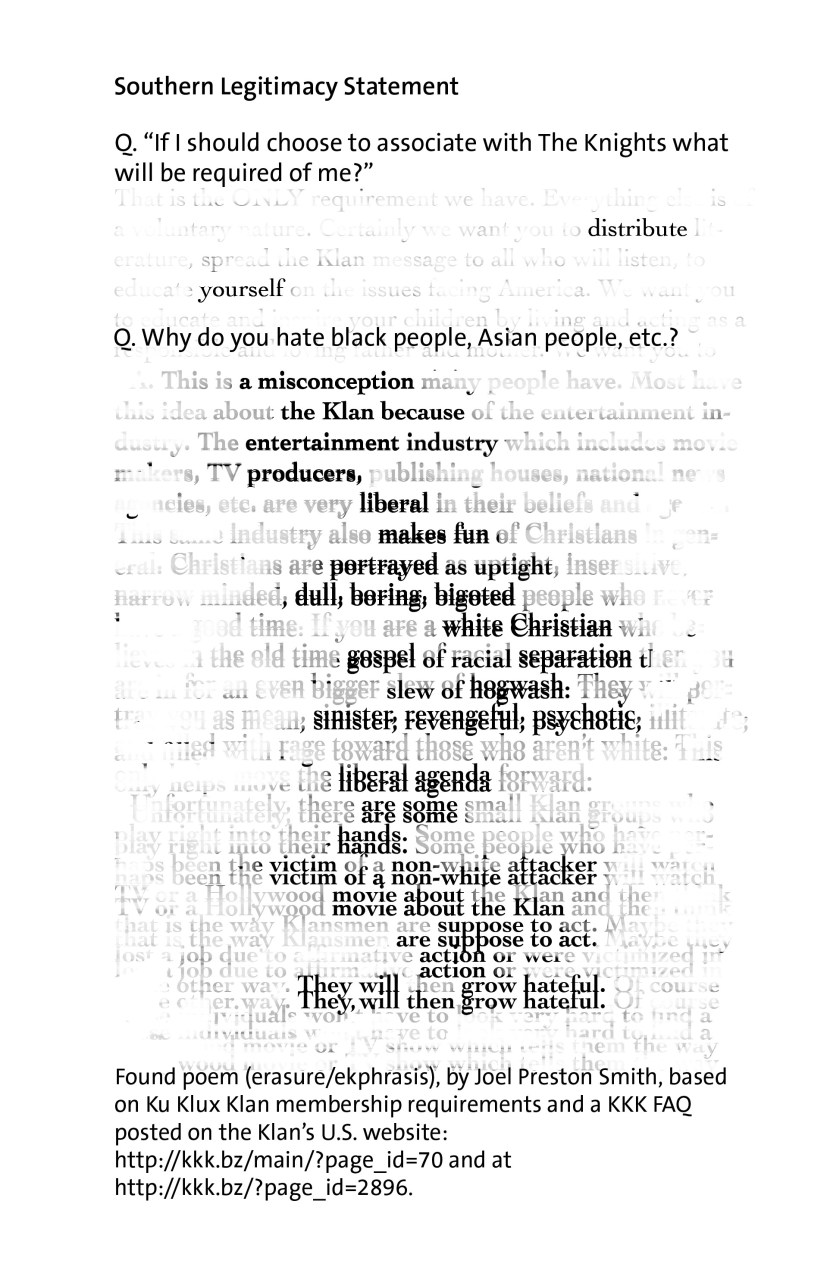
Redaction #1: Southern Legitimacy Statement
“Southern Legitimacy Statement” is an erasure based on the Ku Klux Klan’s membership requirements, and a “Frequently Asked Questions” statement posted on “The Knights’” U.S. website. The redaction was inspired (in part) by submission guidelines for The Dead Mule School of Southern Literature, an online literary journal that requires all contributors to first draft a “Southern Legitimacy Statement.”
The KKK’s membership requirements are listed here:
http://kkk.bz/main/?page_id=70 and at http://kkk.bz/?page_id=2896.
The Mule’s guidelines for a Southern Legitimacy Statement:
http://www.deadmule.com/submissions/
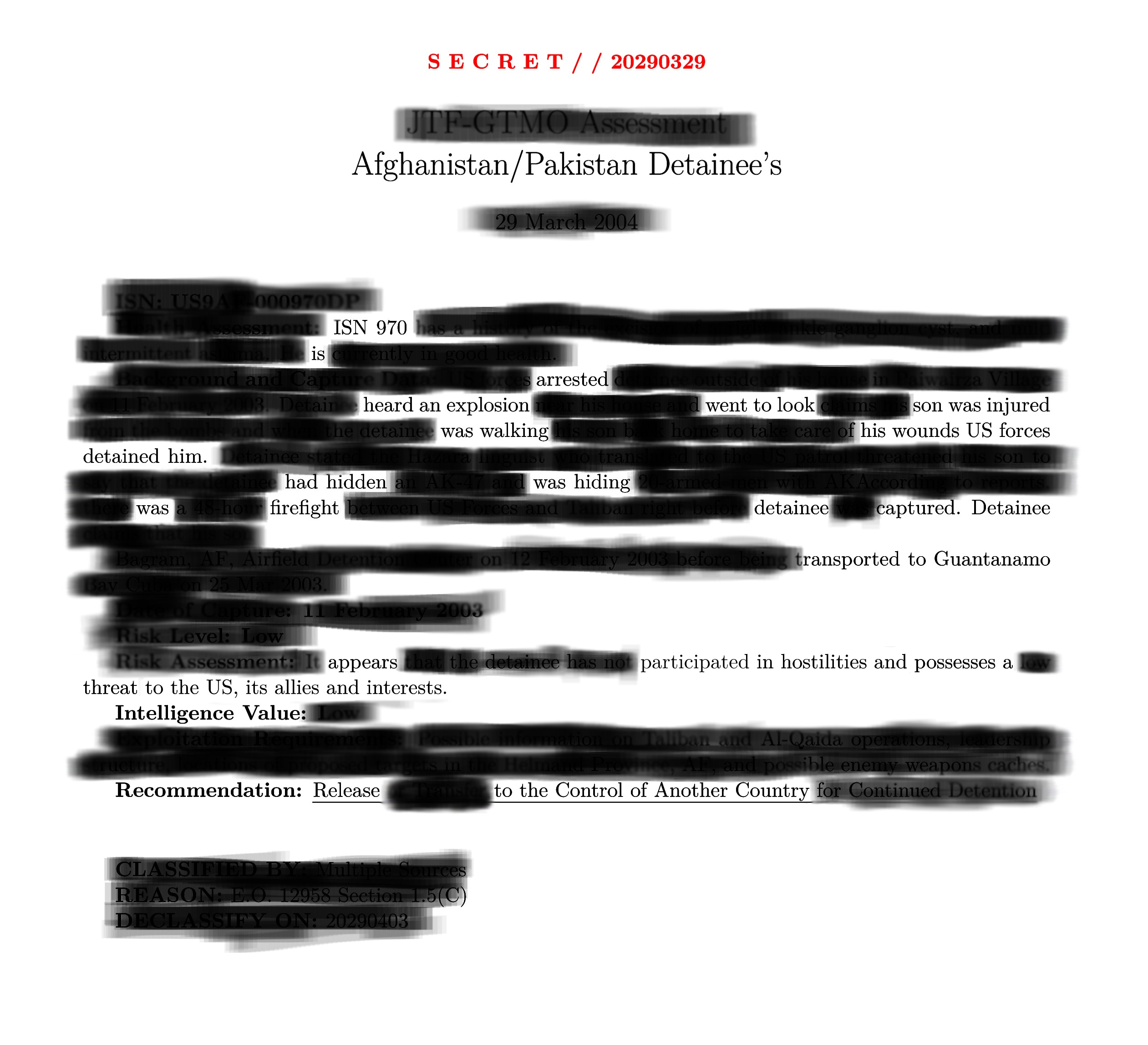
Redaction #2: Secret #20290329: Release to the Control of Another Country
Release to the Control of Another Country is a reverse-redacted, classified military document downloaded through the Guantanamo Files server at http://www.wikileaks.org. Prisoner 970 (who is identified only by first name—Amanullah—in the Pentagon file) was arrested Feb. 11, 2003.
Despite the fact that Amanullah, a resident of the city of Paiwairza Village, Afghanistan, had merely run to the scene of an explosion, had found his son wounded, was carrying him home … U.S. forces arrested him. Thirteen months later he was found to be of low intelligence value. His mistake? While trying to carry his son home, he was caught in the crossfire when a battle broke out between Taliban and U.S. forces. When the battle ended, Amanullah was arrested, then deported to the Guantanamo Bay detention center.
Amanullah’s file does not reference any possible crime he may have ever committed (unless trying to administer first aid to a wounded son is an act of terrorism when ‘perpetrated’ by an Afghani), nor does it charge him with any crime. It does not present any evidence against him whatsoever. But after a year of incarceration (and we can reasonably presume torture), the Pentagon report does recommend his release … or “transfer to the control of another country for continued detention.”
By “reverse-redacted,” I mean I’ve attempted to highlight the absurdity of Amanullah’s capture and imprisonment, rather than obscure the essence of the report; usually a redaction hides the most egregious or damning evidence against (as well as the identifies of) those who’ve constructed the document.
My intention—by doing the reverse—was to highlight the cruelty inherent in determining Amanullah was of “low value,” then recommending he be discarded, by shunting him off to some random prison in some other random country.
There are 779 such reports at the Wikileaks site. Contrary to popular belief, the detainees are not exclusively the nationals of Pakistan, Syria, Iraq and other Middle Eastern nations. They are French. Chinese. Belgian. Canadian … Dutch. According to Pentagon reports, 22 of them have been children. Seven adults have died in captivity. And still they keep arriving. To disappear.
Amanullah’s non-redacted file is downloadable here: http://wikileaks.org/gitmo/prisoner/970.html
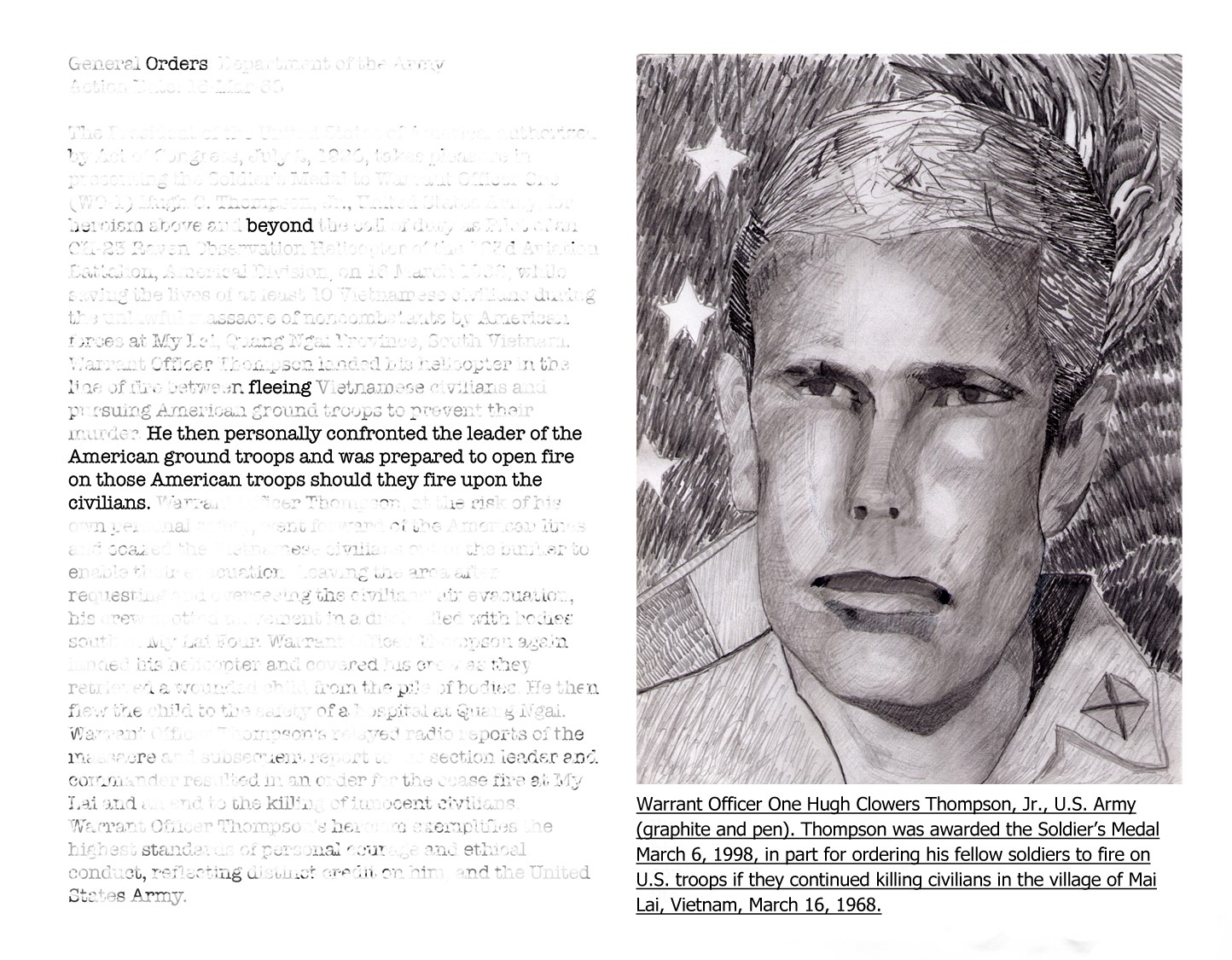
Redaction #3: Orders Beyond Fleeing
“Orders Beyond Fleeing” is a redacted Soldier’s Medal citation for Warrant Officer Hugh C. Thompson, Jr., U.S. Army—the only medal issued in U.S. history to a soldier who ordered his fellow soldiers to fire on U.S. troops. Thompson, a 24-year-old helicopter pilot in Vietnam, was flying a ‘draw fire’ mission March 16, 1968 when he spotted a wounded civilian lying near a road. He saw a U.S. soldier approach the woman, kick her, then execute her.
Thompson, in confusion and mounting rage, began his descent into the village of Mai Lai.
From the air, he spotted the bodies of women and children lying motionless in a ditch, and other unarmed women and children pursued by U.S. soldiers.
He and his two crewmen landed. Thompson dismounted, then confronted Lt. William Calley, a platoon leader in the U.S. Army’s 20th Infantry Regiment. Thompson demanded … an explanation.
The now-infamous Calley—responsible (along with Capt. Ernest Medina) for issuing orders that led to the murder of 504 unarmed civilians in Mai Lai—told him, “This is my business.”
After a brief argument, Calley, who outranked Thompson, ordered Thompson to “get back in that chopper and mind your own business.”
Thompson lifted off. But before he passed the outskirts of Mai Lai, he saw a group of 10 civilians running from soldiers, headed for a makeshift bomb shelter. He dropped the ship between the Vietnamese and the U.S. troops. As he dismounted, he ordered crew chief Glenn Andreotta and door gunner Lawrence Colburn to open fire on U.S. trooos if they fired either on him, or on the civilians.
In one account of the massacre, Thompson is quoted as having ordered, “If these bastards open up on me or these people, you open up on them. Promise me!”
He approached the bomb shelter, began coaxing villagers into the helicopter. He used the ship’s radio to contact another pilot, convinced him to land, to begin an evacuation. He talked a second pilot into landing, and that pilot began loading the wounded as Thompson’s crew continued to shield civilians from their attackers.
Thompson then radioed an area military commander and reported that U.S. troops were murdering unarmed villagers en masse. He demanded the officer issue a cease-fire order.
The order came almost immediately. The killing ceased.
These are not all the actions of Warrant Officer Thompson March 16, 1968. For most of us, even the briefest recollection of his actions … has faded from memory. History itself, perhaps from revulsion, has redacted him—not completely, although the Army has actively pursed Thompson’s erasure from military domains.
Thompson wasn’t awarded the Soldier’s Medal until March 6, 1996, in a ceremony at the Vietnam Veterans Memorial in Washington, D.C. The Army had approved the citation (also awarded to Colburn, and posthumously to Andreotta, who died in combat three weeks after Mai Lai) 18 months earlier, but military officials seemed reluctant to inform Thompson, or bestow the medal publicly.
According to Army regulations, the medal is awarded to a soldier or “members of friendly nations” who has “distinguished himself or herself by heroism not involving actual conflict with an enemy.”
It seems miraculous he lived to accept it. After Thompson filed formal accusations against Calley and the soldiers of C Company (by noon on the day of the massacre), the Army repeatedly sent him into hostile fire. According to a PBS profile, he was shot down four times in an 11-day period following Mai Lai. The fifth crash broke his back, ending Thompson’s career as a pilot.
He retired from the Army in 1983 at the rank of captain, then worked as a counselor for the Department of Veterans Affairs until 2005. In the ensuing years the U.S. Naval Academy and the U.S. Air Force Academy occasionally invited him to give lectures to midshipmen and cadets. In a 28-page profile of Thompson available as a download on the subject of ‘ethics in the military’, Annapolis deftly skirts Thompson’s direct order to fire on U.S. troops. His bio has been ‘revised’ to state that Thompson was “prepared” to fire on fellow soldiers.
Nevertheless, the Academy doesn’t redact his account of Mai Lai—not when quoting Thompson lecturing midshipmen. Not, for example, when Thompson explained why he’d heard so little screaming from children that day. A day in which he says 179 children under age two were murdered.
“A lot of the girls didn’t scream too much,” Thompson told Midshipmen in one lecture, “ … because they had already cut their tongues out …”
During the 1969 Congressional hearings into the Mai Lai massacre he was called a traitor and a Commie. ‘Patriots’ left dead animals on his doorstep. He died Jan. 6, 2006. His parents believed in corporeal punishment. Andreotta waded into a ditch filled with bodies and found a two-year old still breathing, returned to the ship and laid the child in Thompson’s lap. They flew him to a hospital as other pilots continued to evacuate the wounded. In television interviews, after he’d grown old, Thompson ground his teeth and habitually canted his head to the left, as though in a perpetual slow roll, or in the comportment of someone attempting to resolve the face of a figure on some invisible horizon. He once said that “if history is written false, the future is a waste.”
END
Note to editors: The Soldier’s Medal citation is available here:
http://projects.militarytimes.com/citations-medals-awards/recipient.php?recipientid=113312
Other resources related to Thompson’s actions at Mail Lai:
http://www.digitalhistory.uh.edu/learning_history/vietnam/peers_report.cfm
The U.S. Naval Academy’s profile of Thompson:
Click to access ThompsonPg1-28_Final.pdf
*
Joel Preston Smith born in South Charleston, W.Va., is a freelance writer and photographer based in Portland, Ore. He served as a U.S. Army journalist/photojournalist from 1987-1991. His publication credits include New Madrid, Gobshite Quarterly, The Irish Times, The Wall Street Journal, The Oregonian and others. His photography is featured in the French-Canadian film Le Nerf de la Paix, (The Sinews of Peace, directed by Alexandre Kozminksi: 2007), and his photography is in the permanent collection of the Museum of Fine Art, Houston. He is the author of “Night of a Thousand Stars and Other Portraits of Iraq” (Nazraeli Press: 2006; author/photographer) and the co-editor (with Mary Bast) of Image Poem Iraq (forthcoming).”
City of Crosses
fervor and fear. the nuns sent her sister home on a bus/but they wouldn’t even trust her there. ex
-catholic/independent woman in small town texas. she grew beautiful
but no angels led her from new mexico/as redemption sounded out sorry and sorry, a widowed cry
shaking doña ana county./detached from mozart’s sanitized bellows
operatic. she became obsessed with caretaking/to immure a shrine to death. an immunity won by
deliberate contagion/circling around proximities of pain
to mute the larger one/here, a scrape. a bed sore. a pill to ease the always ache. my father’s sisters
all nurses and he fell in love with her. no surprise
and di with cloudy eyes, not corneal inflammation. her pupil an edge/and the strongest, most
muscular of hands. in las cruces
she worked with state and federal prisoners in the medical unit/her fingers drawing blood with
tender precision. shrugging, i haven’t worked with this community before.
the livid shut-eyed colorblind pathologized. said isn’t it a danger there. she said/most of them were
just at the wrong place, wrong time. good people. of course power planned it that way
not the protectors. one day a latino man was abruptly torn from his cell when he didn’t respond to
guard demands/their language thick lazy bullets. no sense there. just violence.
they ripped him from his cage/dislocating his shoulder. broken scapula clavicle humerus as they
beat him then cuffed his hands behind his back his shoulder just hanging
languages of anguish out of joint/guards have no tongues for releasing torture from tonsils. in the
medical unit di yelled let him go he’s hurt. they said he’s a danger.
he’s a danger. echoes illuminate truths twisting intestines. it’s they whose tears materialize profit.
she tended his wounds/testified in front of a grand jury to their brutality
a whispered benediction
*********************************************wrong place, wrong time.
*
Alison Reed’s poetry has appeared or is forthcoming in several journals including Skin to Skin, Cactus Heart, Femme Dreamboat, and So to Speak, and she was recently nominated for a Pushcart Prize. She is pursuing her PhD in English at the University of California, Santa Barbara, where she is taking a brief respite from the city life she longs for.
Corvus
eating persimmons meant for crows/is the combination of uppers and downers/the weight of
branches can withstand against the snap of me. for they have their own
bellies and tire of doubling as benches for feathers heavy/with nevermore. thick-billed raven of the
motherland/a home for diasporic longing
performed painfully in grass skirts and face masks grafted onto roman busts of women/whose lips
leak violence of
why sex can never settle bets. i bit into your flesh so like an apple/so like shiny wet sheen sin
swelling in my mouth/scoffing at the numbness that means
the end of you.
*
Alison Reed’s poetry has appeared or is forthcoming in several journals including Skin to Skin, Cactus Heart, Femme Dreamboat, and So to Speak, and she was recently nominated for a Pushcart Prize. She is pursuing her PhD in English at the University of California, Santa Barbara, where she is taking a brief respite from the city life she longs for.
Heidegger, 1966
he said what is awesome is that everything functions. the terror of it all. a god in decline pining over
sweaty plutocracies/ever increasing unities
functioning faster toward a certain death derailed by the promise of metal and screws./i want
someone to intervene in the disorder of things
it’s not a gravity/less flag but a massive shift in perspective not made possible by technologies that
drive and derive from this endless functioning.
he wants a radical rupture/a messianic promise/a futurity determined by tradition but tradition is
never a singular sign extended to a force outside us
tradition contains its own felt histories/which multiply and wash over petrified containers of
words. of wounds.
there are others, speaking/but they do not require his ear to interpret. they weigh their own
meanings./he dreams of another symbolic system that never sacrifices its own
but his language is too functional. it records a presumption that one can master time or transcend
its grip/and everything keeps functioning. cannot be stopped.
everything functional assumes too much.
*
Alison Reed’s poetry has appeared or is forthcoming in several journals including Skin to Skin, Cactus Heart, Femme Dreamboat, and So to Speak, and she was recently nominated for a Pushcart Prize. She is pursuing her PhD in English at the University of California, Santa Barbara, where she is taking a brief respite from the city life she longs for.
Necropastoral for the Mississippi River
********Is this heaven?
********No, it’s Iowa.
********—Field of Dreams
At night the grass
ticks lemon sounds
each bladethroat slick
with pollen, dust, air
stocked with nitrogen
corn ultraverdant
in the hoar-pale night.
This yardgrass of the Midwest
foams its sow-scented earth
into miniature whitefists
to stay the ground and watch
the rain parading past
as snow geese flood the sky
abrupt new populace
fulminating in the poles
crude company for
such artifitted flows.
The river sings
to yards and to
the laboratory men
we are free
we can do anything.
The sun is in its morning house
counting out its birds
who raise their dust-
colored feathers
into a persimmon sky
before dusk makes
of us blankshapes
and drifting ships
who sail unmeaning into
the artifacting night
where the dark’s compressed
til the blacks break up
into haloes of shadow
into sunsets of squares.
To project ourselves
into the blown-out sun
or the whitened sands
of Puerto Rico or Mexico
is not to escape from a ground
consecrated with glyphosate.
We are always
being followed
by the brown tilled river
and the blue-green tide.
Are bodies more
impressive than light?
Agricola: a tonic
made of corn.
Perforated cattle
rocking in their stalls.
Cultura: refineries of meat,
the farmers and their dying wives.
Text me that
reassuring voice.
Text me tomorrow
as a bright, hot thing.
We are free.
We can do anything.
What good comes of telling
the fishers of the south
how calm must be contrails of corn
how orderly the silken ears
and fat the cows and hogs
to thicken the sleep of men
with scarce lightning
mortgages, mortality
affordable goods
fording the shores of a river
who stairsteps down hills
with her frills of fish
or burrows her rifts
like a great salamander
waving its tail
to command the weather?
Such flashes:
childhood, adolescence
flickering away
as viral video
or archived in the cloud
til nothing’s left of us
but light, numbers,
code aloft, enclouded,
not quite dead
nor quite alive.
Quickened. Free.
We can do anything
where the algae blooms
incessantly and where
you’ll find our things asleep
our bakelite and bandaids
our hairnets and plastic
tambourines aswirl,
refined, entombed
by a dream of light.
*
Mary Austin Speaker is the author of Ceremony, winner of the 2012 Slope Editions book prize; The Bridge (Push Press 2011); 20 Love Poems for 10 Months (Ugly Duckling Presse 2012); and a collaborative play, written with her husband, poet Chris Martin. New poems have appeared in Boston Review, Jubilat, Forklift Ohio, and elsewhere, and her critical work can be found in Pleiades and Painted Bride Quarterly. She lives in Minneapolis, where she designs books for HarperCollins, Milkweed Editions, The Song Cave and others. She will teach at the Jackson Hole Writers Conference this June.
Necropastoral for the Carribbean Ocean
We’ll put out to sea
And we’ll perfect our chemistry
By and by we’ll defy
a little bit of gravity
—The Beach Boys, Kokomo
To bare our skin
and enter into congress
with salt and water’s air
we bob indulgently
in emerald seas.
Emergencies demur,
even those fossils
that make the porous land
agree to form and beach
and scatter into sand.
We forge our mountains
and the rivers reel.
So stark the driftwood’s
flesh-pale skin
gets polished in the wind,
so too our raging stones
and claw-sharp shells
are rolled and rolled
until they are so many
and distilled they lie
in layers, crests, accrued
tectonic plates.
We root between their layers
for shale’s percussive burn
and boom, the bust
a black thought shuttled off.
Having left the ocean
the land retains our residue.
Others fall away and then return.
Today a prayer is made
of waves and crumbling cellophane,
the softened bits that blend into the sand:
green, blue, white, ecru.
This detritus, once ours, erupts,
our lineaments and trinkets,
everything we ever had
a thorny gift for birds and fish,
the mangrove’s salty mass.
So place inside
each bottle
a greeting for the plovers,
snails and kelp.
To send a word
with everything
we send away
is to pull
tomorrow’s string
and see millennia flare.
Our things outlive us:
form and chemical,
each valence
potent as a fuse.
Let need dry up
to counterbalance use.
*
Mary Austin Speaker is the author of Ceremony, winner of the 2012 Slope Editions book prize; The Bridge (Push Press 2011); 20 Love Poems for 10 Months (Ugly Duckling Presse 2012); and a collaborative play, written with her husband, poet Chris Martin. New poems have appeared in Boston Review, Jubilat, Forklift Ohio, and elsewhere, and her critical work can be found in Pleiades and Painted Bride Quarterly. She lives in Minneapolis, where she designs books for HarperCollins, Milkweed Editions, The Song Cave and others. She will teach at the Jackson Hole Writers Conference this June.
 Matter