
Category: Issue 34
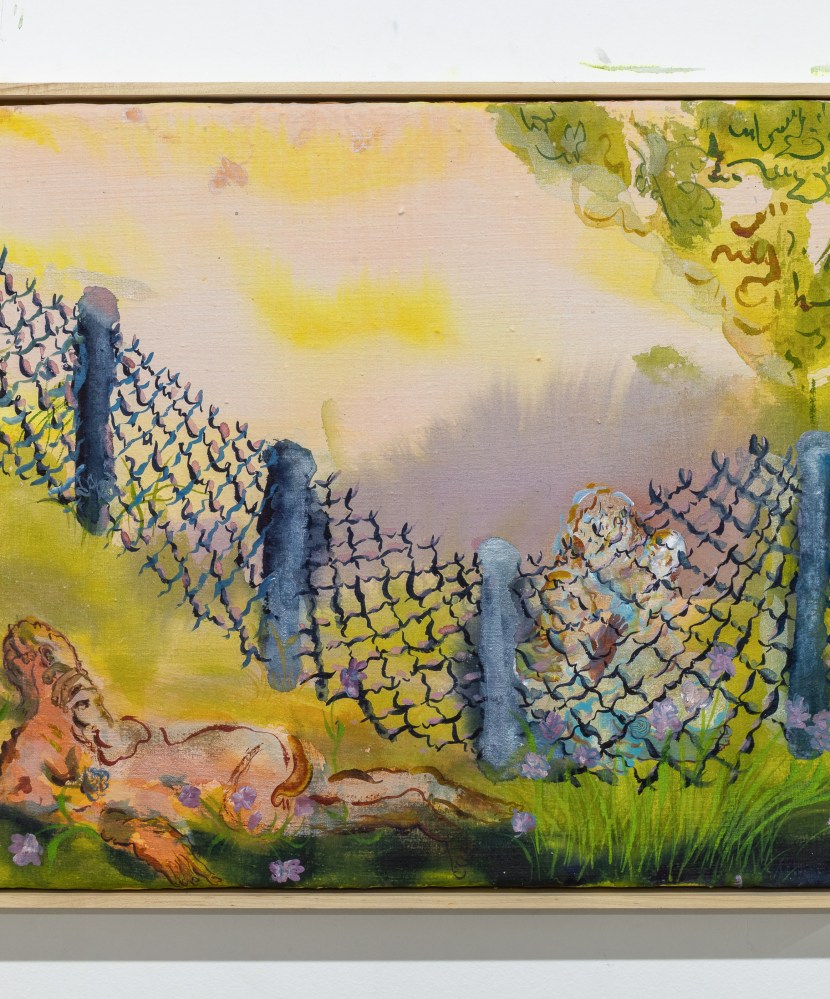
Art by Michael Haight
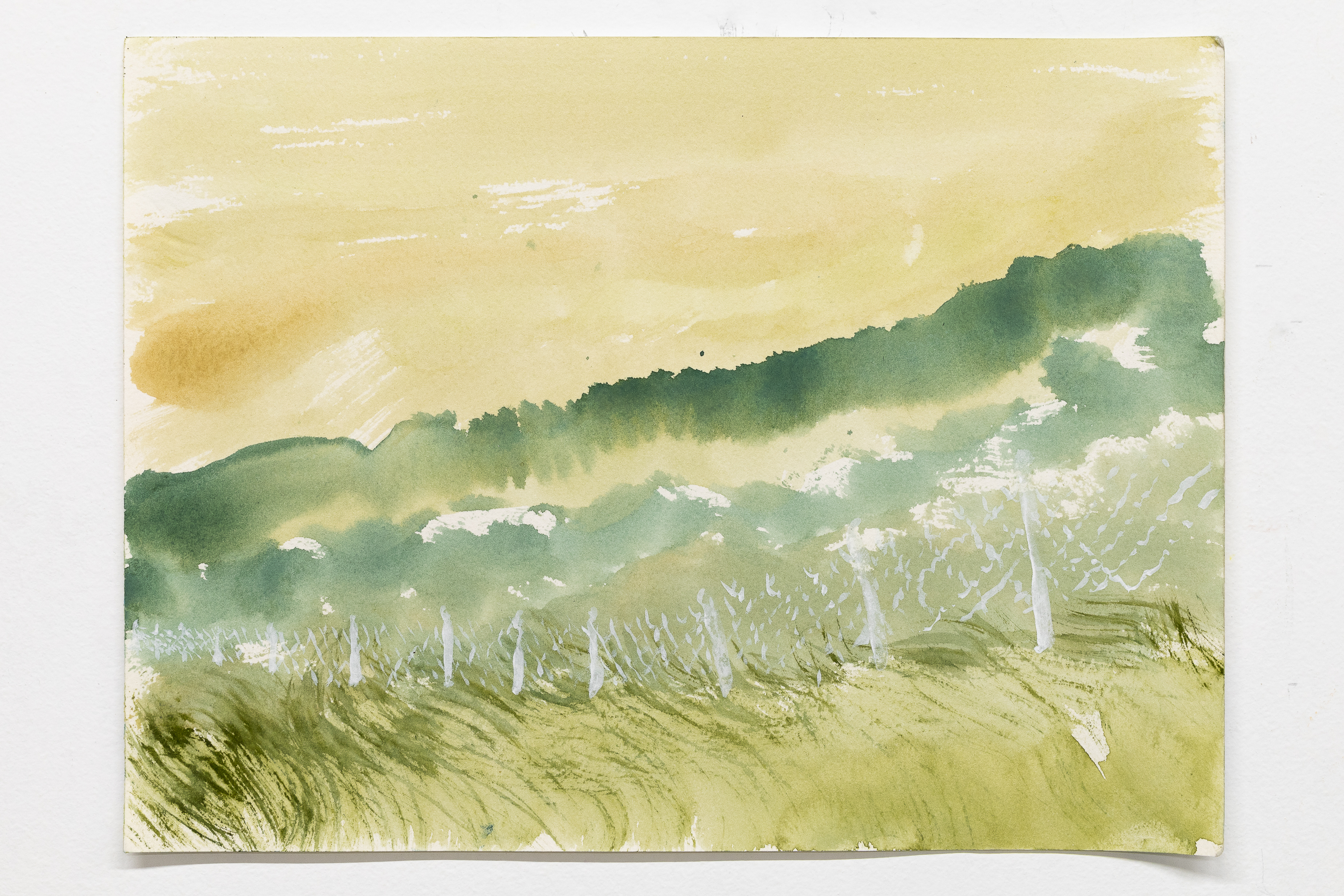
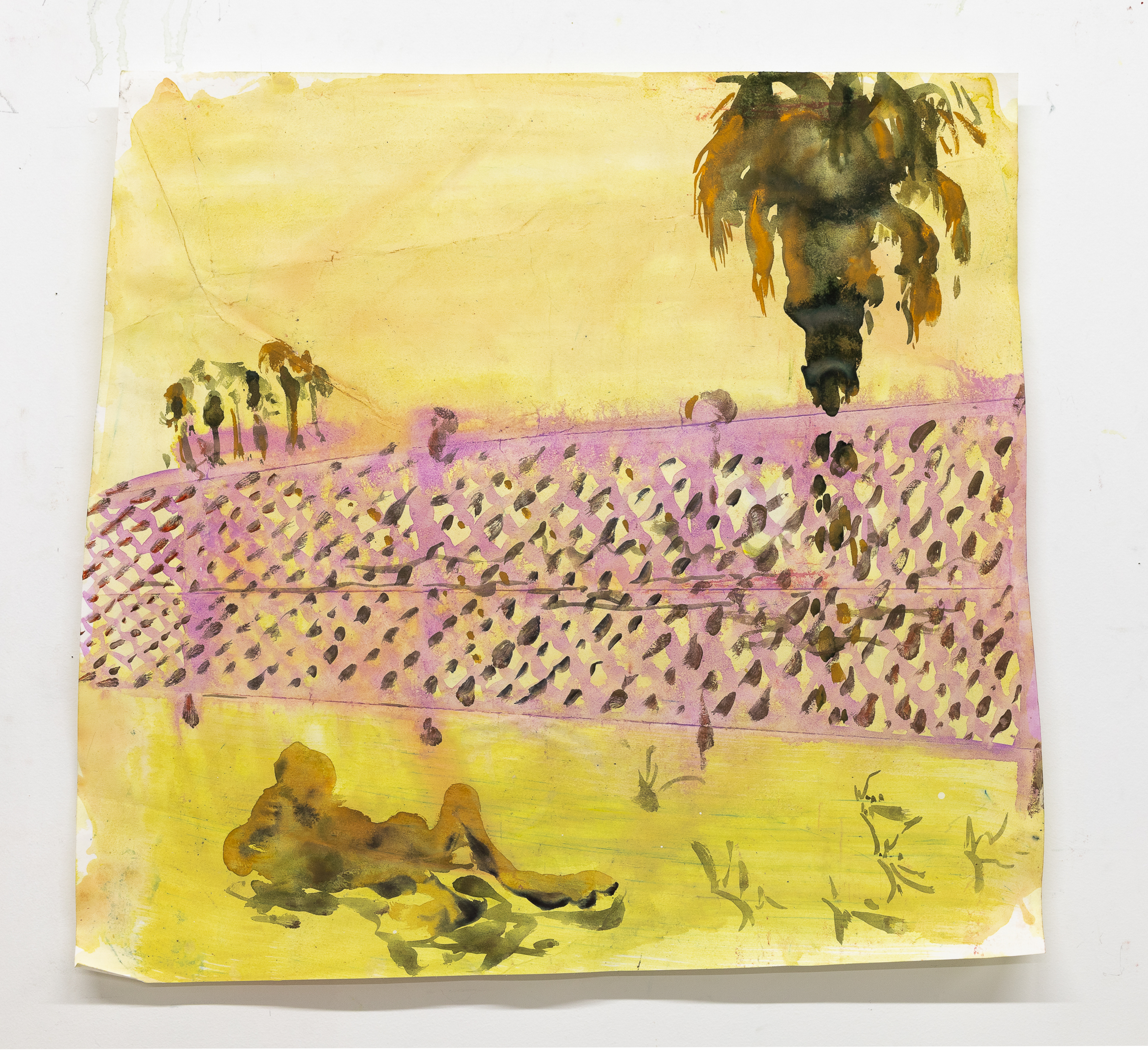
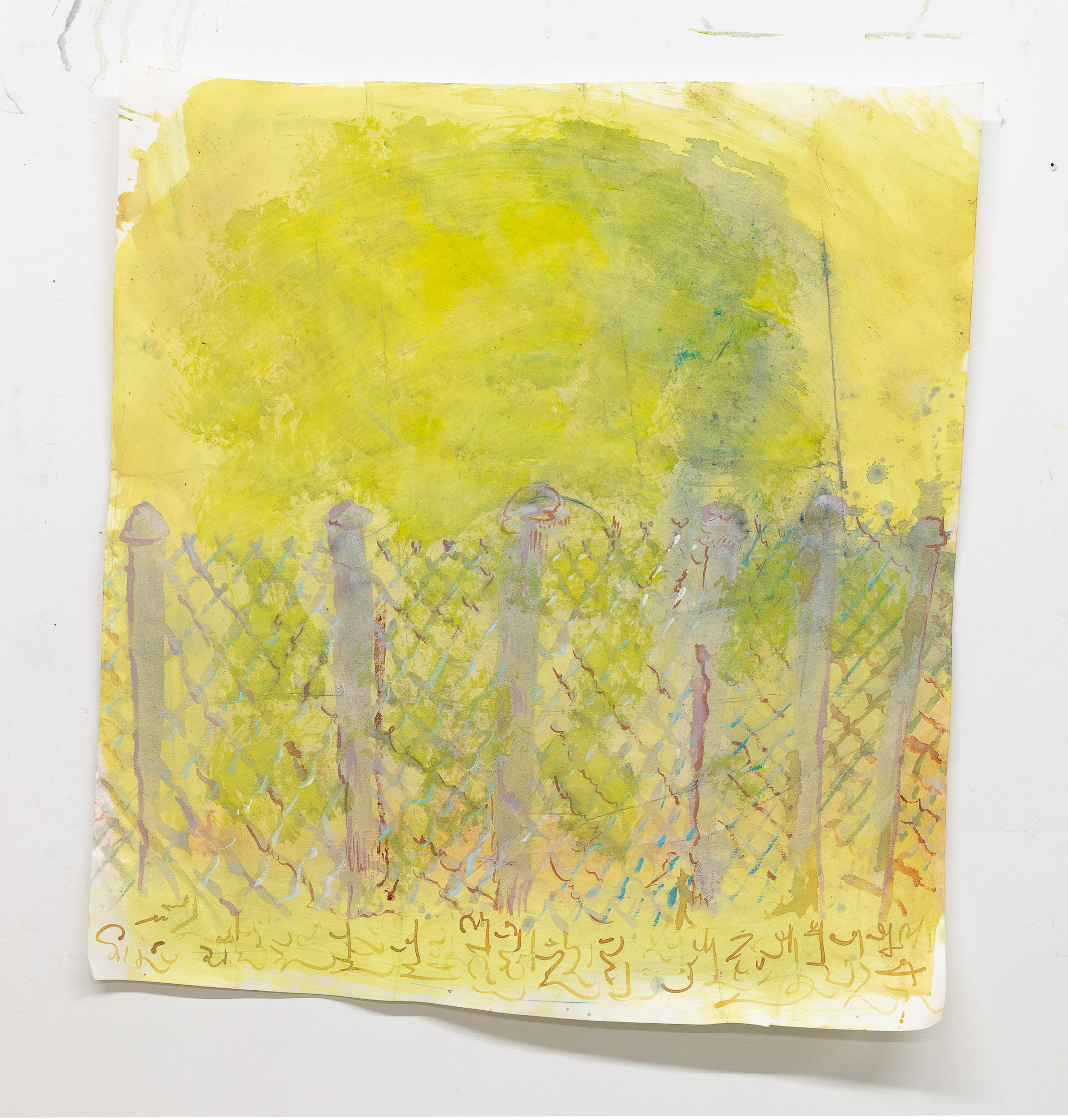
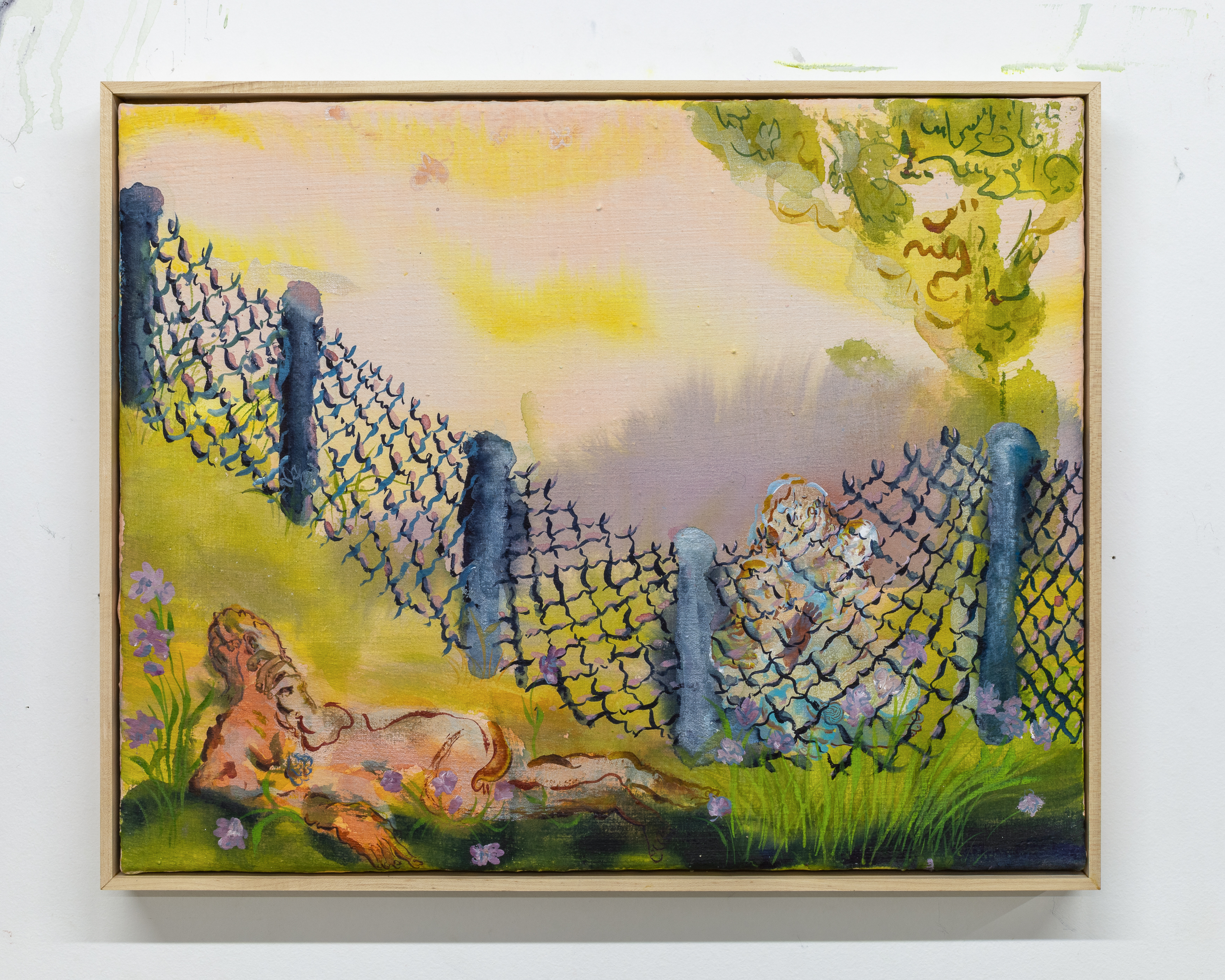
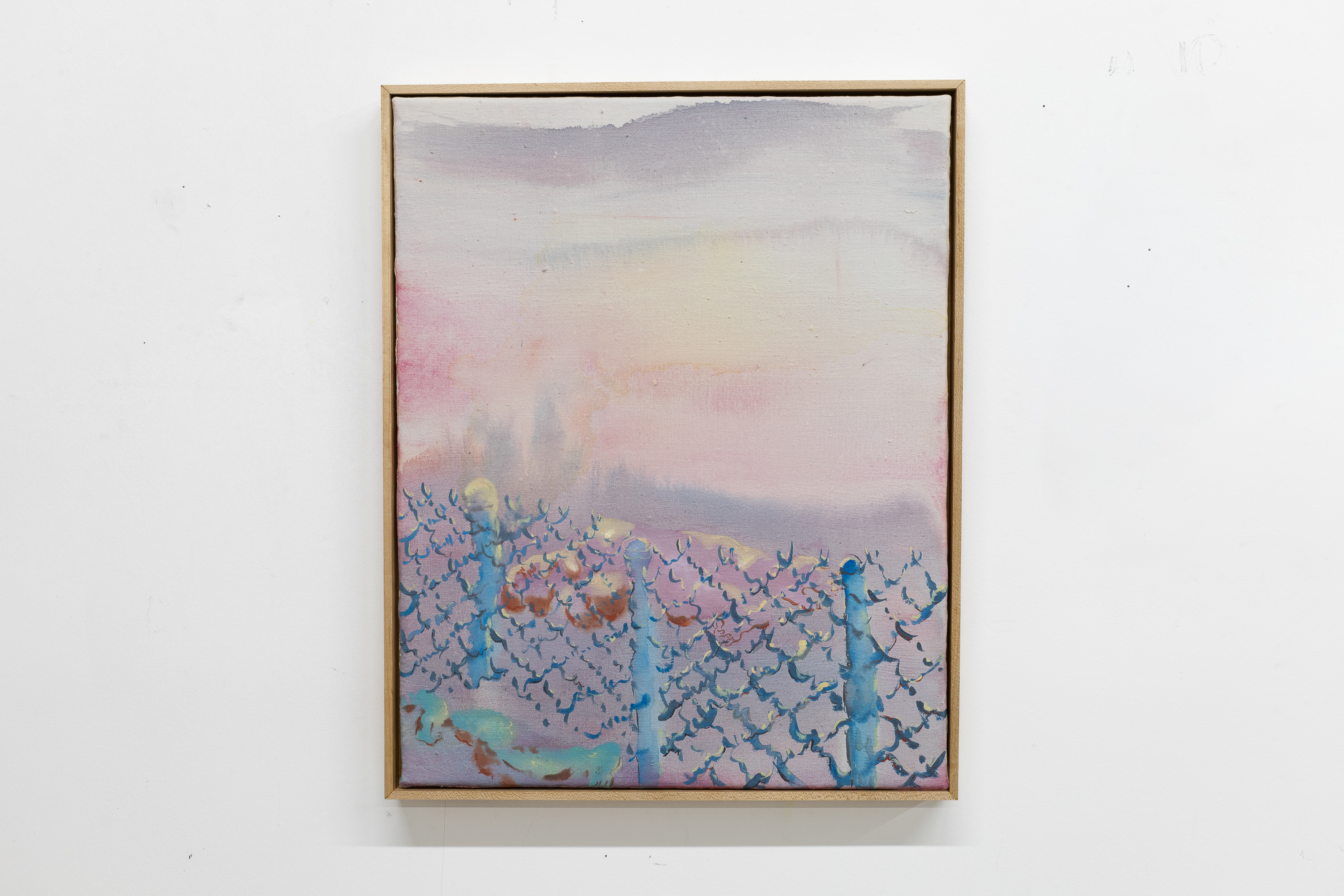
What began as meditations on the fence as a form, bisecting nature, became an instigator of narrative—a catalyst of change.
Personally, the concept of a chain-link fence is tied deeply into my past-lived experience as one of the first goals I accomplished.
As a child who lived with chain link surrounding his house and the orange groves around that, I saw fencing as something which showed me what I could achieve
by overcoming it. Being able to climb chainlink meant access to the fields, and those orange groves and dirt roads in Perris, California.
From that point onward, fences began to take on a different meaning, from achievements to delineations of space, warnings, privacy, separations between self
and other.
Fences began to be seen as violent ‘things,’ as reckonings, as exploit, as a place to piss.
The fences in these paintings take me back to a romantic nostalgia; the linking metal as script, as flowered beams of light.
The fences obstruct.
The fences abstract.
The fences hide.
Each scene is charged by its fence.
Each Fence is a slicing of imagery.
This fence and that fence a poignant symbol—each evidence of human existence, of human politic, of human territory, and human border.
Each fence communicates potential to figures at every side.
*
Michael Haight (b. 1984, Fontana, CA) was raised in the Inland Empire of Southern California, and now lives and works in Los Angeles, CA. He holds a BA in Creative Writing from the University of California at Riverside, CA and an MFA in Visual Art from Claremont Graduate University in Claremont, CA. The Artist has shown in spaces throughout the US and Europe including Solo Exhibitions at My Pet Ram in New York, NY(2023); One Trick Pony in Los Angeles, Ca (2022) and Group Exhibitions at Good Naked, Los Angeles, Ca (2024), La Beast Gallery, Los Angeles, CA (2023); Phillips Auction House in London, UK (2022); G/Art/En Gallery in Como, Italy (2022); One Trick Pony Gallery in Los Angeles, CA(2024); Lyles and King in New York, NY(2021); UTA Artist Space in Beverly Hills, CA (2021); OCCCA in Santa Ana, CA (2021); LACE in Hollywood, CA (2011) and Cirrus Gallery in Los Angeles, CA (2011-2012). His curatorial projects include Group-a-Therapists at Kippenberger-Beuys Gallery in Glendale, CA (2016), and Being Present Mafia at Soze Gallery in West Hollywood, CA (2016). His work has been featured in the publications Hyperallergic (2023), KCRW (2023), Architectural Digest (2022), New American Paintings (2021-2023), Art Maze (2021) and the collaborative book, with the Poet Cutter Streeby, entitled Tension: Rupture (Tupelo Press 2021).
Five Poems by Samia Mimo
Introduction by Tiffany Troy
Samia Mimo writes: “My body is a fable my mind refuses to read.” Like the room that the poem’s speaker dwells lives in, it bears witness for her other unbroken half, of possibilities that do not seek to be erased by soap. I loved the grace in the “silly continuity” in the face of the immensity of “I am born with a cracked hymen too”, and “peace in the form of a rollerblading Barbie and not depravity in the form of touches in a cage.” There is a solemnity in Mimo’s diction that complements the sexual trauma of her female speaker.
I. the room
There’s nothing special about the room: I live in it still, the walls still stare down at me and the queen-size bed still cradles me like my mother. Something in it lingers and rots from 2021, maybe it’s fear or humiliation or reality. Reality is something that has never lied to me, a silent god in my mouth and the only god that has never needed me to be on my knees.
The humiliation is something else, something that I still cannot name even though it’s on the tip of my tongue and behind my eyelids when I close my eyes. I cannot name the feeling of his hands nor the way his voice echoed in my ears nor the way I froze. The fear is nothing anymore. Or maybe it is something. There is always that small doubt that creeps in because I don’t remember anything but humiliation and fear. When did it happen? How old was I? The room remembers and the memory festers—ugly, alive.
- the cleansing
Soap tastes funny. I’ve always liked soap, all the different colors and scents and the solid feel of them in my hand. It was always meant to clean off dirt and make me smell like I belong to this world. Now I wash with a fervor until my body aches and prunes up. Maybe it’s an odd routine, maybe it’s that I like the water hot, maybe I’m not trying to erase anything. It foams up and washes away a little too fast.
- the robbery
Mythology says that original humans were born with two heads, four arms and legs, with immense power that even Zeus feared. It is said he cut them into two and we’ve been searching for our other half since.
- the longing
Who is it—what is it? What is it that I’ve been searching for? Sometimes I think I wasn’t cut into two. I think I was carved out harshly. Something essential was taken from me. I feel like I’ve been robbed when I’m overcome with grief like never before. Who could I have been, unbroken?
- the body & mind
My body is a fable my mind refuses to read. It holds every ache, every touch that has long faded. My mind builds walls around it, calls it healing, but my body hums in this constant static. It must argue sometimes: my mind declares it’s over and my body whispers it never was.
- the good ending
There isn’t one, truly. But the mornings are nicer—I wake up and I look at life and think about how beautiful it is. I drink coffee even though I hate it, eat a little too much sugar everyday, and move through the ordinary. I think it’s grace, this silly continuity. But it’s enough to live without choking on the what-ifs of life.
[hungry]
watch me crawl on hands and knees
barely breathing and angry
the kick, the ache, the need
hissing prayers
as fickle as a butterfly that feeds.
silence, it fights and it flees
it can kill or be crushed
maybe calamity scratches
in His throat and He swallows
i am glorious on fire
my throat has been sedated
artemisia—i am not afraid
the darkness i become
it will mould around the mouth
screaming
GIN AND TONIC & RADIUM
his teeth gnaw me clean off the bone
but i awake with an anger, brightly burned,
my mouth opens ugly and the stars fall from it
i drink my anger like rum, let it burn my heart.
bright red, i am reborn
even the dark cannot look at me
“you survived.”
the old gods chant my name
“they seized you like they did to us.”
feast on the girl i was
HYMENAEUS COMES TO MY DOOR
I cannot remember it anymore, I just live in its consequences—
blessed in the way God will forgive his sins but not mine.
God still feasts with the devil, eats an apple of his own,
an apple that will never plague him like it did Eve.
I am its aftertaste, the rot in his mouth,
the orchard left trembling.
I am born by guilt, I am born from her rib, I am born with a cracked hymen too.
I committed a crime I have no memory of— you silly girl, you seduced him — but my wrists are bound by his nails and this is mercy for my unholiness, an exorcism, and punishment.I asked: for living? No, for letting your blood rush down your thighs before he consumed you, because who would want to leave the Garden of Eden?
TEARS AND AN ENGLISH MUFFIN
ABOUT THE MAN.
I will save you when the darkness swallows us whole.
You will float face-down in the Dead Sea and I will use my body as an anchor to save you even though all you deserve is to remain dead.
I will outgrow you by years.
You will die when I am 27 and by then I’ll have lived too many lifetimes to even try to remember your name until it comes to me on a wicked night in the darkness of my bedframe.
This is not mercy.
ABOUT THE GIRL.
This is not mercy.
I will save you when I remember you still exist somewhere.
You will find the fire cold on your bones and I will wrap you with my insistence and it will be the warmest thing to you.
I will die before you crawl out of the dark.
You will rest with a certainty that your final memory will be peace in the form of a rollerblading Barbie and not depravity in the form of touches in a cage.
*
Samia Mimo is a second-generation Bangladeshi American who finds a home amongst words. Having grown up reading, writing, and thinking a little too much, she has no doubt that she spends too much time inside her head. She writes across multiple genres—most favorably poetry and fiction—about feminism, her personal experiences regarding trauma, and retellings of myth.
Three Poems by Grace Ma
Introduction by Emily Liu
In Grace Ma’s poems, she explores how people who live in the same city lead drastically different lives shaped by their expectations, privilege, and troubles. In Ma’s poem “Better Days,” she highlights the contrast between privilege and struggle through the life of a homeless woman. The woman is referred to as ‘she’, keeping her identity vague to represent others facing the same struggles. Ma writes of the comparisons between ladylike “women dressed in their best,” while she becomes “something she’s not” to survive. More comparisons highlight the dangers of being vulnerable at night without a home, where her only protection is her German Shepard. Ma does not resolve her poem with an ending, forcing us to rethink the unknown reality we often overlook when we see homeless people. In “Avenues Away,” Ma uses rhymes and alternating lines to contrast a boy and a girl with opposite resources and mindsets, despite attending the same school. Although their actions mirror each other, the girl has more privileges, such as being able to buy water, take the classes she wants, and being driven home. The girl’s environment of support and choice has cultivated a mindset that encourages learning and curiosity, whereas the boy’s environment has created a limiting mindset, believing “he has no way to advance”. Ma’s poem brings awareness to stark differences between upbringings and privileges that shape a person’s belief in their future. Ma’s poem “hello?” is intentionally unformatted with fragmented lines, portraying the chaos of her sister’s mind. Her sister’s artistic struggles and the societal pressure for it to be perfect consume and isolate her in her room. Written from a sibling’s perspective, it explores themes of misunderstanding, worry, perfectionism, and how they can distance family members. Ma’s poems touch on everyday issues she sees in her life that many can relate to. She writes in powerful rhymes and imagery, evoking emotional understanding, allowing the reader to connect with parts of her writing.
Avenues Away
The blonde haired girl walks down the halls of the shiny waxed floors
The tan skinned boy walks down the halls through the broken doors
She sits next to the window reaching from the ceiling to the ground
He sits next to the smartboard, yet there’s barely any sound
She glances at the textbook shelf, the possibilities are endless
He glances at the textbook shelf, it’s a mess
She grabs an ice cold water from the machine close by
He grabs the knob of the leaky water fountain, maybe it’s still worth a try?
She quickly rushes to change into her gym uniform
He quickly rushes to gym in his regular clothes, it’s the norm
Today she learned how to ballroom dance
Today he learned how he has no way to advance
As she approaches the cafeteria there’s no line
As he approaches the growing line, he begins to whine
For her lunch period, many people bring their own
For him, school provided lunch is all he’s known
She takes a few more classes, all catered to her interests
He takes a few more classes for credits, failing every test
She leaves school in her mode of transportation
He leaves school in his mode of transportation
She turns onto Warren ave in her mom’s car
He turns onto Warren ave too, but home is very far
Better Days
Today she settles in the corner of a bank
The bags left on her usual park bench were snatched away
She watched the officers gather around as her heart sank
Oh well tomorrow will be a better day
The air in mid July was hot
She could not afford to keep her layers on
She folds her long hair into her cap to become something she’s not
In her dreams she pictures a big grand house with a beautiful lawn
It is around four in the morning when two men try to approach
Her german shepherd gets up to bark
The men don’t dare to step any closer as they reproach
Anything can happen in dark
The sun comes quicker than she would’ve liked
She looks across the street at a group of beautiful women dressed in their best
Unlike her, they seem so ladylike
She looks down at her little nest
The day has just begun, but she’s not sure she wants to stay
She glances at herself through the glass doors reflection
Oh well tomorrow will be a better day
hello?
i think my sister has a problem
her room is a mess
crumpled papers
everywhere
each project she works on needs to be perfect
whatever that word means to her
anyways
i dont understand her art
clashing patterns and fabrics
i was taught to never do such a thing
she doesnt listen to anyone
i offer her pages of my old magazines
no
not good enough
how
i think to myself
she’ll work on her pieces
for days at a time
sometimes weeks
we’ve given up on trying
to get her to come downstairs
even for dinner
*
Grace Ma is a junior at Stuyvesant High School who is passionate about bringing light to issues that are usually overlooked. In her free time she enjoys tutoring kids as she believes that they are our future. Her consistent love for learning about all sorts of world history has taught her the injustices of society and the importance of not falling down those paths once again. Her work for this project was heavily influenced by what she sees on a daily basis: homelessness, education inequality, and a lack of support for growing artists. She hopes her poetry will help ease people into facing these harsh realities.
Two Poems by Emily Liu
Introduction by Grace Ma and Gavin Cheng
We had the pleasure of reading Emily Liu’s two poems for this Matter issue, and readers, you are in for a treat!
Liu’s first poem “Mulberry Stains” explores the pain of saying goodbye to your childhood home. What does it mean to have it exist only in memory? She begins by characterizing mulberry stains as a reflection of her home, her community, and the joy of sharing, growing, and picking food that her family can eat. She highlights how the good times spent in that house will always be remembered with a hint of bittersweetness. In her old home specifically, fruits and vegetables came fresh from the backyard. Although the house may have seemed far from perfect to an outsider, that home helped her flourish into who she is today. She then goes on to say how urban development has demolished her childhood home as construction companies dug into the ground and “Instead of fighting nature’s persistence, / they choose to erase our tree’s existence.” That home and the families surrounding it will always be part of Liu. Her second poem offers readers a completely new take on her writing.
In “A Heavy Toll” Liu expresses her passion towards environmental preservation by taking us through the horrors of bottom trowling in our oceans. Liu’s poems both address the core idea that humans prioritize development over preserving nature’s gifts. She describes the process “Like a storm tearing through a luscious field, / leaving only a barren disaster,” giving the ecosystem no time to recover before it is repeated again. This piece is both informative and emotional as it walks us through the process while giving a voice to the wildlife that suffers from heartless human practices. Each of her line helps to show the intensity of the practice and the permanence it leaves on our society.
Mulberry Stains
Wind blusters against oval, serrated leaves.
It grips and tugs, pressuring the weak stems
that feed the ripening mulberries
struggling to cling on.
As the berries surrender the losing battle,
they detach and fall;
A path of scattered stones beneath awaits.
Worn with regular footprints and nature’s paints,
ridged slabs of stone draw a map,
laying the trail towards home.
Coarse brown dirt interweaves the stone,
where grass grows and ants resurface.
I recollect my upbringing in Fujian, now a sixteen hour flight away.
My home was shined on so brightly it burned,
the only shade brought by looming trees
and under the cover of night.
Fujian soil nurtured our fruits and vegetables–
Persimmon, apple, lychee, mulberry,
each brightly colored fruit brought color to our enclosed community,
each savoured the sun more than any human could.
Squash, watercress, white cabbage,
each grown by a different family but shared together as one.
Our families gathered each summer night,
shaking a giant of a tree with our hanger retriever poles;
Used for laundry, plastic grapples atop of a light-weight stick
clamped onto branches.
With only a slight jerk of the hand,
Berries shook and detached easily.
Overripe mulberries connected and bled,
leaving dark purple splatters as evidence.
They dried into stains,
painting the coarse, brown dirt.
The ones that stay whole
promise simple sweetness.
Without washing or care,
they jump into our mouths
to cool us from the Fuzhou summer heat.
Only now, the same city surrounds two halves,
easily distinguishable by development.
As construction dominates nearby,
our old stone paths guiding the dirt
contrast with freshly poured white canvas;
our three-story community
contrasts with glass skyscrapers ruling the city;
our simple berry tree pressed berries to our windows,
yet from above shrinks into an unintelligible dot–
blurred into the business of the city.
The same community that once held generations of families,
that once bloomed conversations daily,
now separated across the city,
pushed apart by new construction.
Along with that faded the joy,
the joy of gifting plentiful, oversized zucchinis and cucumbers,
the joy of watching Monkey King
on a community 13 inch TV under the moonlight and evening breeze,
the joy of knocking on 10 doors in five minutes,
collecting friends to play in the river.
We were no exception to the urbanization,
impeding towards us.
During construction, the developers knew
the stubborn mulberry stains
would continue to seep into the concrete,
that is if our tree was still standing.
That is nature’s design,
programming mulberries to anticipate
soft dirt to envelope their seeds.
Instead of fighting nature’s persistence,
they choose to erase our tree’s existence.
So as the buildings are struck down,
the mulberry-stained machinery roars
against the audacity of the roots,
when dirt paths are finally suffocated with concrete.
Our blackberry tree is replaced
by a lifeless, stain-free fountain.
Enveloped by a pristine canvas,
glistening, where no life dares to emerge.
A Heavy Toll
Foreign, heavy nylon nets drag along the seabed.
Hungry, greedy, undiscriminating.
Full of man-engineered mechanical power,
the boat tied to the net dominates the ocean waves.
The small, fast-moving, snagging squares
graze coral reefs like pebbles,
sifting through water like air,
striking the sand upwards like explosions.
Like a storm tearing through a luscious field,
leaving only a barren disaster.
Light struggles to pierce through the thick curtain of sand,
to reveal the smallest of fish that slip through the net’s wrath–
left to grieve over the vast emptiness.
Again and again,
Before life can return and begin to dream of flourishing,
An engine hums above once more,
Threading along another thickly woven nylon net to catch ‘loose-ends’.
Bottom trawling, designed to catch cod, but instead
disrupting hundreds of species,
displacing billions of sediments,
clouding meters of the seabed,
suffocating millions of animals,
stealing days of light from plants,
discarding tons of once alive, unwanted fish, like waste.
Their home becoming their resting place too soon,
unnatural deaths marked by our hands.
*
Emily Liu is a Chinese American who grew up in Fujian China, then moved to New York City. She is a Junior at Stuyvesant High School, living in an age where there are more issues than one can bring awareness and change to. As a student passionate about biology and ecology, she often learns and observes human impacts on the environment on a global scale, and also on a personal scale. She hopes to bring awareness and action towards fighting environmental issues, big and small, through poems.
Three Poems by Gavin Cheng
Introduction by Stanislaw Chadrys and Tiffany Troy
Gavin Cheng’s poems uses humor to process the pressure-cooker academic expectations that shaped him. He begins “Calculate this baby” with “When I’m sitting at this cold, hard desk/ talking the SAT, some thoughts escape/ me. ‘Are those who sneeze a lot the most blessed?'” The world of the imagination–in the moments of peace (in distraction, in playing the game of Monopoly “those Saturday mornings” are short-lived) even while pointing to the speaker’s desire for proximity, and a desire to feel ENOUGH.
Calculate this Baby
When I’m sitting at this cold, hard desk
taking the SAT, some thoughts escape
me. “Are those who sneeze a lot the most blessed?”
before ringing myself back in to the math
wiggling around on my screen
like a cry for help.
My calculator is taunting me with all
different symbols, begging me to
understand. Yet it just doesn’t happen.
Maybe I need a break.
I take a trip down my brain’s
rabbit hole into nothingness. You know
what people always say? The richest people
never did well in school.
Words flow like a river that creeps into a
big and beautiful ocean. Numbers are the big,
ugly dam in the way of that path. Blocking all the
little fish that are trying to be part of something bigger.
Rage ignites me to focus back up again. The dam
is present for a reason. Maybe the reason is hidden
in variables—why x keeps running away. y do i have to
do this at all?
It still doesn’t work. My mind drifts off,
wandering to places no Standarized
Aptitude Test can measure. Stories I have to
tell and all that I have to say.
I finally know why the dams are there.
Rivers need
a little challenge every so often.
A Time Away
I remember those Saturday mornings
when we would rise
at the crack of dawn to
build imaginary houses and
hand out fake money like
masters of our own world.
We would never finish the game,
yet it still happened like clockwork
every week. I wonder if you still remember
those simple times.
Those times when I would move my piece
while you were distracted. Properties bought
and hotels sprung to life. But it has all began
to fall.
Do you recognize the laughter
dying in fraying threads?
Can you see the base starting
to tremble?
While I am away for hours on end,
you crawl further away,
stuck on opposite sides of a labyrinth
and unable to find our way back.
I know that we have both began to sprout
but do a sister and brother have to
lose their bond? Before it shatters completely,
how can it be repaired?
When the clock approaches zero,
we will look back feel the weight of
all those fateful Saturdays. Take
a picture because that’s the best
it’s gonna get.
Unlace Those Shoes
He came out of nowhere and knocked me
to the ground. There was a thump but the whistle did
not blow.
Keep going.
Get up.
You can’t complain.
Fight for every loose ball.
Fight for every last scrap.
It’s what my Ah Ma used to tell me. We have to
work for everything because nothing is given. I
could hear her familiar accent, always talking about
how hard she worked to come to America.
Ai ya Gavin, when I was younger I had
to walk 3 miles to go to school. You watch Iphone
all time and Dad drive you to school.
I came out of nowhere and knocked him
to the ground. There was a thump but the whistle
blew.
Stop now.
Sit on the bench.
You did something wrong.
Not fighting hard enough for the ball.
Not fighting hard enough for the scraps.
It’s what my Ah Ma tells me now. Be as
perfect as you can because that’s
the only chance you are going to have. I can
hear her reassuring yet stern tone, always talking
about how she survived in America.
Zhicheng, you compete against so many other
people like you. I own restaurant, can’t go to college.
But you can get Ivy.
Suddenly the gym lights feel too bright.
I’m not doing ENOUGH.
*
Gavin Cheng is a junior at Stuyvesant High School in New York City, whose lifelong love for books has inspired him to pursue creative writing of all different genres. As a basketball player himself, he is passionate about sports equity and how gambling intersects with professional sports. Through Writing to Make Change, he hopes to use writing as a tool to spread awareness about these issues. In his free time, he serves as the Vice President of the Stuyvesant Fishing Club, an organization that provides veterans with opportunities to go on fully funded fishing trips.
Three Poems by Ilora Bhattacharyya
Introduction by Tiffany Troy
Ilora Bhattacharyya’s “Pixelated red heart” documents the “doomscrolling” emblematic of the post-COVID modern age. Rather than Edgar Allen Poe’s tell-tale heart, we have the “pixelated red heart” of Instagram and social media, influencers, and fake news. In this way, the mother figure serves to uproot the speaker’s fixation, albeit only momentarily, in the bit-sized lines that mirror the shortened attention span endemic of social media. In “What faith doesn’t feed” and “Silent pleas,” Bhattacharyya attempts to give voice to the women and the animals, and what is surprising about the turns in both poems are the speaker’s ability to connect the visceral shouts of a protest with her own interiority (“Words that shouldn’t be said”) and to make visceral the pain of laboratory animals.
Pixelated red heart
I’m eating dinner at the table
Fork in one hand
Phone in the other
Mindlessly scrolling
Illuminating that red pixelated heart
My digital praise
For these gorgeous
Happy
Perfect
Looking people
Eat this
To look like that
Buy this
Don’t wear that
That’s “out”
But this is “in”
A checklist for existing
Being fed information
That I don’t know is true
But do I really care if it’s true
Because as long as all the boxes are ticked
Then I’m safe
I’m enough
It’s an addiction
That I can’t tear myself away from
This silent self-degradation
It’s swallowing me whole
Consuming me
As if no online presence
Means no presence at all
Because it didn’t happen
If I didn’t post it
Who cares about being in the moment
When I could get a hundred likes
And be praised in the comments
By my followers
My “friends”
For this beautiful
Enviable life
That I’ve carefully curated
A life that’s not really mine
My mom says to put my phone away
At the dinner table
But she just doesn’t understand
Doesn’t understand that I have to
Like and comment and share and respond
That I have to stay present
What faith doesn’t feed
We are in the 21st century.
You say abortion is immoral,
Prohibited in your religion.
So now she doesn’t get a choice,
She doesn’t have a voice.
Why does your God
Dictate her life,
Seal her fate?
Will it be your faith who feeds her child
When she cannot?
You say pro-life,
But not hers.
Not the life,
Not the body
That’s living, breathing,
Fighting, bleeding.
We are in the 21st century,
Yet still we march,
Still we shout,
Words that shouldn’t have to be said:
My body is not yours.
My body is not theirs.
It is mine.
Silent Pleas
Muzzle around the mouth
Chain around the neck
Tail between the legs
Their innocent souls
Consumed by needless pain
That human hands inflict
Their once pure and curious eyes
Now gleam with fear and apprehension
With questions and silent pleas
That they feel so deeply
But can never voice
They wonder what it’s like
To have enough food in their stomach
So they don’t feel their ribs stab
At their tender skin
To have the comfort of a roof overhead
That doesn’t feel cold and confining
Like that of a cage
With no escape in sight
And they wonder how it is
To be touched with gentle hands
To be held with loving arms
To be seen by a pair of eyes
As something worthy
Not expendable
Not disposable
But deserving of the love
They want to give
*
Ilora Bhattacharyya is a student at Stuyvesant High School and a guest editor of Matter Monthly.
Three Poems by Tafheem Ahrar
Introduction by Shayna Wilson
I am thrilled to introduce Tafheem Ahrar to our Matter readers. In Tafheem’s folio of poetry, he grapples with what it is like to witness others’ lives from a distance, and how to understand experiences beyond one’s own. The first poem focuses on an immigrant mother whose domestic work and sacrifices often go unnoticed. Her choices, such as raising her siblings and giving up her education, model dedication and perseverance for her child, creating a foundation for them to pursue opportunities the mother never had the chance to experience. The second poem explores the discomfort of watching violence in Gaza through a phone while others experience destruction firsthand. Viewing the war from the comfort of home emphasizes the speaker’s inability to act and highlights their privilege in contrast to the lives of others. Lastly, the third poem questions online behavior, showing how constant reposting can weaken the seriousness of real issues by turning them into something temporary or performative, leading the speaker unsure of how to engage meaningfully online. Ultimately, these poems raise questions about seeing others for how they truly are, and what it really means to witness and value other people’s experiences.
DO NOT TURN OUT LIKE ME.
My mother tells me this while tying her scarf,
while her hands float through the pots and pans, rinsing rice.
As she sits down at the end of the day to talk to me
her voice shakes sometimes.
She tells me she should have learned English
and that she never studied
and that she is useless.
Do not turn out like me.
Do not turn out like me.
Ammu, you stay home all day,
our home quiet except for the soft sounds you make
moving from sink, to stove, to laundry basket.
I record our conversations on my phone sometimes. Your laugh floats up between the clatter of lids and spoons. Then your voice grows thin when you talk about the dreams you gave up in Bangladesh.
The schooling you lost to take care of ten.
Your parents who left you behind to move to America.
The siblings you raised and fed because no one else could.
If only I had studied. If only I had learned English, you say.
If only.
At night, when I find you at the kitchen table
your hands finally still
America is different. Here, nobody cares about how much land your family owns. Nobody asks who your cousin is or who your uncle is. They ask what you can do. I cleaned people’s kitchens. It was normal in Bangladesh. I didn’t have much respect or status but that didn’t matter much because I knew what you were capable of. I want you to walk into rooms and feel respected. I want you to have a job where your back doesn’t hurt at night. You will study. You will become what I let go.
Ammu, you think your life is small
because no one clapped
when the clothes were clean because of you
when the meals were ready because of you
because you gave
and gave
and gave.
The truth is, if I ever become the future you wanted for me, it will only be because I spent every step I took toward becoming you.
When the bombs fall in Gaza,
the glow reaches my phone first.
A boy my age runs through smoke,
calling a name the wind carries away.
I sit in a room warmed by a heater
I forget I turned on.
I watch the video twice,
as if repetition might steady something.
The light on my face
feels too clean for what I am seeing.
My day continues the usual way.
School. Homework. Dinner.
His day folds into dust.
I brush my teeth
while a family brushes debris
from a doorway that no longer exists.
I notice how still my walls stay
when I set my phone down.
How easily the quiet returns to me.
How badly it refuses to return to them.
So I keep watching,
not because I know what to do,
but because looking away
feels like another
kind of violence.
At night my room glows blue
from the screen I hold over my chest.
The house is quiet.
My feed is not.
A father carrying his two daughters
appears again,
one in each arm,
their faces turned away from the camera.
He kneels beside their mother
as if placing them gently back into the world.
I lock my phone
but the image stays pressed
against the back of my eyelids.
The next morning there is Sudan,
a red river seen from satellite,
or someone said it was blood.
I still do not know if it was real,
but it did not feel fake
in the way it made me sit up straight.
My feed becomes a row of identical frames,
the same colors, the same captions.
I pause over the repost button,
Sometimes I tap it.
Sometimes I look away.
Sometimes I open a fundraiser
and sit there a moment,
and close it again
before I decide anything.
I talk to my friend about all of this.
How it feels like we have failed people
we have never met.
How silence feels wrong
but speaking feels unsure.
How every crisis becomes a trend
and I am scared
of treating suffering
like a passing moment
in a long, endless feed.
Late at night
I watch my screen dim to black
and I can still hear
the faint tapping of my thumb
searching for the right thing to do
for a world I only touch through glass.
*
Tafheem Ahrar is a Writing to Make Change student at Stuyvesant High School.
Two Poems by Barbara Krasner
Budding Correspondent
While I wait for the presidential election results,
telling myself this can’t happen twice,
that democracy will be dead, as dead
as my grandfather who sat up straight
at West Hudson Hospital in 1969 and said,
Thought I was gone, eh?
I gathered packages of red construction paper,
went with my father to Hotalings in the city
to buy Pravda, only because my grandfather
came from Minsk, but in my imagined job
as twelve-year-old foreign correspondent,
I could read Cyrillic and extend my arms
as bridge between Old and New Country. How
had Grandpa voted in presidential
elections? Did he vote for Al Smith in 1928?
Being a journalist and understanding Russian
could help me understand him, because
his phlegmy hack made it difficult
to hear him in any language. I didn’t know
then he had Yiddish stuck between his teeth,
had to scrape ancient letters from his tongue.
I made a red scrapbook. Presented to my class.
My grandfather died. I wore plaid to his funeral.
Urban Planning
The houses in Zaromb are drunks in Shmul’s Tavern,
gold teeth glinting against mullioned glass,
sweat pouring pine needles from Leshner Forest.
The streets in Zaromb are broken wagon wheel spokes,
whittled wood laid bare without bark, oh, wait,
there’s a chicken crossing Fama Street looking
for the feeding time when it was called Farbasker Street,
after it was called Yossel’s Street, the continuation
of Moshe the Locksmith’s Street as it passed
the Brok cesspool that once surrounded Zaromb
on three sides. Look at the frogs on the lily pad
among the algae that drowned the mezuzot
until the boxes shot up into the linden trees,
their parchments hanging out to dry
the skin of the homes they once protected.
The marketplace in Zaromb is the OK Corral
that lost its High Noon moment because
the sheriff only had the six-pointed star
but no gun. The well stinks of dried grass
lured from the banks of the Brok and dried
dreams crowbarred from cracked thresholds.
All of this produces a town map, that drawing with pencil nib,
slickened with mouse saliva before the cats crawled in
and buried the mice in kitty litter.
*
Barbara Krasner is a New Jersey-based poet and historian. She is the author of ten poetry collections, including The Night Watch (Kelsay Books, 2025), and the forthcoming The Wanderers (Shanti Arts, 2026). Her work has appeared in more than seventy journals, earning her multiple Best of the Net, Best Microfiction, and Pushcart Prize nominations. She holds an MFA from the Vermont College of Fine Art and a PhD in Holocaust & Genocide Studies from Gratz College.
Folio of Poems by Belarusian Female Poets Translated by Nathan Jeffers from the Belarusian and Russian
Valiantsina Aksak
When looking
When looking for a day’s happiness-
finish off the bottle.
When looking for a week’s happiness –
roast a turkey.
When looking for a month’s happiness –
take a husband.
When looking for a century of happiness –
tend to the flowers
in your old man’s garden.
(Translated from Belarusian)
Vera Burlak
Lullaby
Sleep, my son
Cockroaches scurry over plaster,
Screeching pipes moulder.
My love, slumber on.
The schizophrenic neighbour
Takes aim
But his rocks miss
Our window pane.
Shh, don’t wake.
On the stairwell someone’s shooting.
They’re at the door, it’s shaking.
Someone’s climbing through the window
Caught in the drapes, flapping
Like in a spiderweb, hanging
But that was a long time ago
That corpse long cold as snow
Sleep my sweetheart.
Planes over cities spinning
Tails flaming.
Wings lodge in graves below,
Each hole filled with an arrow.
Bullets buzz about the road
This is no gunman attack
In fact
The wind carries them on its back.
Miss Mary Mack Mack Mack
A black veil lay on the floor
All is shut at the store
Moms and Dads left to snore.
Only I’m, like that elephant, not sleeping.
Someone is quietly singing
About those drinking,
Teeth tapping
On their glass of Valerian tea
This is a lullaby for thee.
A palace of old postcards, built by spiders.
A wood waits, frozen, for the loggers’ sawing.
Golden bells hang in the air ringing.
My son, my son.
My darling soundly sleeping.
Dreaming of me.
(Translated from the Belarusian)
Maryia Vaitsiashonak
An ordered life
When you’ve not filled
the stove with wood
for tomorrow
nor fetched
water
from the well
then you’ve no
future
only a dreary, lingering
today
(Translated from Belarusian)
Untitled
Once the light
is out
the hut
closes
its eyes
the crunching
bones of the
old wardrobe
shelves
put themselves
to bed
at dawn you discover
a nail on the floor
like a pin
from a woman’s
hair
the hut is alive
(Translated from Belarusian)
Volha Hronskaya
Untitled
When I enter the kitchen,
to wash the dishes,
I call myself Agatha.
I’d have liked something
more romantic, but
what to do
I’m no nymph.
Agatha.
Forty, divorced, in creative crisis,
and I hate washing the dishes.
Since childhood I remember
how dishes begat rituals.
Heat up the water
fill a big basin
dunk, scrub, lift
all without soap
so the crumbs
can be fed to the pigs
you scrub flowers on a white plate
with slippery fingers
and you hate washing the dishes.
I once read that:
when you wash the dishes
you should think on the dishes
and this gives a moment
a feeling of self
I think:
maybe that’s the reason
for my diagnoses, crises, desires?
I hate washing the dishes
and I don’t feel.
But
when water trickles through my fingers
they feel wet.
Perhaps I can be cured.
(Translated from Belarusian)
Iryna Dubianetskaia
This is no tree
No
that’s
no tree
that grows in me
roots upward
but – flame
fanned by the wind
that burnt my tree
its nest and blossom
it thirsts to burn me too
but the tree
I grow in
forbids it
his crown
touches
the clouds
(Translated from Belarusian)
Olga Zlotnikova
Untitled
To Misha
Before you understand
that you’re travelling platskart
in a blue carriage
on the train from Minsk to Sevastopol
The sun will fall
a white shuttlecock
beyond the forest
and all shall be dark
For now there is tea
in a cupholder, on the ledge
pink sausage slices on bread
passengers chew silently
the sullen attendant passes by
You climbed to the top bunk
sky stretching out
sky never ending
a pale blue in the midday haze
Trees will flicker endlessly
trees in dark clusters
and those fields upon fields
A longing more than longing
under a July sky
on the train from Minsk to Sevastopol
The radio forever buzzing
songs pressing as the heat
songs which must be shed
like burnt skin
or discarded like cigarette butts
out the window, into the wind
face shielded from ash
my love, we’re still moving
sun leaning to the west
nature fathomless
beyond the carriage glass
blurred by the scratching
nails of a bored little boy
I’m afraid to tell you
that you won’t see the sea
the splendid Black Sea
it’s already night now
the sky darker than never
my boy
don’t lie on the edge
of the top bunk
in the platskart carriage
of the train from
Minsk to Sevastopol
(Translated from Russian)
Nadezhda Kokhnovich
Untitled
You’re weird mama, like a swimming pool
you have to think less in your head
why don’t you want nice hair?
I took out the hairclip, I made your hair beautiful,
shake it out!
what if crocodiles climbed out of all the bins?
and what if birds stole the car?
they’d go all over town, making accidents
what if you had three heads?
what a pretty scarfy you have mama
glorybetoukraine, what a beauty you are!
you, mama, are a French princess
no, a French policewoman!
what do animals have claws for?
and what if their claws reached up to space?
what if a planet gets pulled down,
tied to a statue and pulled down?
and then what if snakes slither downstairs,
but upstairs there aren’t any, what then?
and what would happen if you clip monkeys’ nails?
and are there electric screws?
and will you tell papa about grandad’s questions
from before?
and what if there is a body?
and what if you dance inside a rocket?
and if you turn the tap on so loads of water comes out?
and if you turn the tap on, shut the door and run away?
what if there’s a juice flood?
what if there’s a chocolate flood?
and if there was a big flood in our house
would we have to, like, swim in the water?
and then what if everything rots?
I’d better not think about it
it’s like a nightmare!
(Translated from Russian)
Hanna Komar
Body in Progress
On the road there isn’t a flower or tear
Just a bell in my ear ringing…
I want to be my own body again
not red, nor white, nor black
or hands holding rebuke
but barefoot upon the grass
I take a thimble to wear
and stroke your hair
when I use my fingers this way
imagine my heart
a woman alive
not a banner raised,
nor a hope,
I want to give myself
my voice and body back,
maybe I never wanted anything more
than that…
(Translated from the Belarusian)
Nastia Shakunova
Apple tree
We’ll play at buttons or coins
pull out a long stick
from the shed, or a slingshot
to knock apples from high branches
nearby is a pond with rusted locks
the bottom covered with silted skeletons
of carp, frogs, and statues
but not one boat
The oak and foundations
of a ruined bathhouse on the street side
naked women doused each other with water
from zinc buckets
washing children in basins
later used to boil ripe berries in
scooping off the foam with a big wooden spoon
and they would sleep
when the sun set
topping and tailing
if all together
We’ll pull out a long stick from the shed
and play at buttons or coins
(Translated from Russian)
*
Nathan Jeffers (ig: @jikooo) is a translator, writer, and teacher. He translates from Russian and Ukrainian into English; translations released in 2024 include the posthumous memoir Socrates the Skinhead, the Life of a Russian Antifascist (Active Distribution) and The Art of Ukraine (Thames and Hudson).by Alisa Lozhkina. His translations and other writings have appeared in the Asymptote Journal, the Los Angeles Review of Books blog, RHINO poetry, and Pocket Samovar. He is also currently working on translation projects with Oxford University, UK and Rutgers University, USA.
Valiantsina Aksak: Born in 1953, she holds a degree in history and has worked as a journalist. She has published 9 poetry books and lives in Minsk.
Vera Burlak: Born in 1977, she is a writer, translator and performer. Her poems and short stories have been translated into German, English, Czech, Polish, Russian, Ukrainian, and Esperanto. Since 2023, Vera Burlak has been living with her family in Stuttgart.
Maryja Vajciašonak: Born in 1940. A trained teacher and journalist she is the author of books of essays, stories, memoirs and children’s fairy tales. She has written 6 books of poetry and lives in Belarus.
Volha Hronskaya: Born in 1978, she is a poet and a prize-winning translator from German into Belarusian. She lives in Minsk.
Iryna Dubianetskaia: Born in 1964. A doctor of sacred theology, she has worked as an editor and university lecturer. She has published poetry under pseudonyms in various publications and lives in Minsk.
Olga Zlotnikova: Born in 1987. A graduate of Belarus State University, she has published two poetry books and lives in Minsk.
Nadezhda Kokhnovich: Born in 1988. She is a translator, essayist and editor. She has one book of poetry published and she lives in Minsk.
Hanna Komar: Born in 1989, she is a poet, translator and writer.She has published five collections of poetry. Her work has been translated into Polish, Ukrainian, Swedish, Norwegian, German, Czech, Lithuanian, Slovenian, Danish, Italian and Russian. A Freedom of Speech 2020 Prize laureate from the Norwegian Authors’ Union. She is currently undertaking a PhD at the University of Brighton and lives in London.
Nastia Shakunova: Born in 1989, she has self-published one collection of poetry as well as online and she lives between Homiel and Minsk.
Poems by Shayna Wilson
Introduction by Samia Mimo
It is a pleasure to introduce Shayna Wilson to Matter readers. In this folio of poetry, Wilson turns a refined and intimate eye towards her own life. Crossing 96th St follows the gentrification and red-lining of Manhattan through her devotion to 96th Street. Despite the mischaracterization of her home, Wilson insists change can be made because “if policy build the divide / policy can dismantle it / block / by / block.” However, Wilson’s second poem focuses inward. You Melt My Heart intertwines the deep mutual love between the speaker and her grandmother, and the quiet, accumulating guilt of not reaching out more often. This poignant poem deals with the balance of love and distance by questioning why “its hardest / to return love / to the ones who give it freely.” Across these poems, Wilson explores complicated histories and private tenderness in a single frame, while dealing with how love can foster.
Crossing 96th Street
Five apartments shaped my childhood,
their ceilings watching my growing body
as if they were witnesses
to every version of me I evolved to be.
With each move, my eyes widened.
Not just in age,
but in awareness.
I learned Manhattan speaks its biggest truths
in the smallest distances.
From the Upper East Side’s pristine streets,
grand brownstones lining each block,
tree-lined sidewalks swept clean
before most people woke,
and then across 96th street-
the heartbeat of Harlem,
where something in the air
shifted.
Sidewalks grew cracked,
and corners collected trash
that never seemed to leave.
Some blocks were loved,
others neglected.
Long before I learned of redlining,
I felt its outline
under
my
feet.
1930 maps drawn
with biased hands, painted
Black,
Latino,
and immigrant neighborhoods
with warning labels: Hazardous, risky, undesirable.
Families locked out of mortgages,
denied homes and investments,
while desirable white neighborhoods
were showered with loans, development, and opportunity.
Those red lines never faded-
they seeped into the concrete.
I now walk along their consequences
every single day.
A mere ten blocks
separate my Harlem home
from the Upper East Side.
Yet the difference stretches farther
than any map could measure.
The cute cafes and bookstores
that once felt ordinary
now feel like luxuries
I no longer see.
Instead,
Mc. Donald’s signs burn through the night,
casting a glow over cracked storefronts
where local businesses could have thrived.
cherry Valley –
A small chain grocery store
in the place of Whole Foods –
with aisles left sparse,
bruised apples under buzzing lights,
green lacking to the eye.
Buildings sag with the weight of years;
Rats slip through gaps
where investors never bothered to enter.
For years,
I hesitated to bring friends home
holding my breath for their reactions:
Why are there so many projects here?
I almost got jumped by a homeless man!
They notice the disparities
between my streets and theirs.
Their words press against me,
like another boundary line.
But change is not too distant to reach.
New homes, rent-stabilized and standing strong,
funding flowing into worn bricks and cracks,
filling the gaps.
The question was never why some neighborhoods flourish-
the answers are written everywhere.
It is why we continue to allow others not to.
If policy build the divide,
policy can dismantle it,
block
by
block.
The next child who crosses
the 96th Street boarder
Should not feel the weight of two worlds
split by a line that never should have been drawn.
Let them walk freely,
unburdened by history’s reminiscences,
into a Manhattan where every block
is equally cared for.
You Melt My Heart
Grandma was the first person
to see me
February 28th, 2009.
The first face I saw at the hospital,
the day I was born.
It was as if that moment
stamped me onto her heart
forever.
Her contact sits in my phone-
Grandma,
beside the purple heart
I placed there at age ten.
Why did I think
a single emoji
could hold a lifetime of love?
Westchester weekends at her house,
cuddled in the cream den
beneath the fluffy Mets blanket.
Grandpa suggesting movies –
Mary Poppins,
Ferris Bueller’s Day Off,
Are We There Yet?
Grandma saying –
let her pick.
After many goodbye hugs and kisses,
train tracks hummed beneath me.
I pressed my forehead to the window,
Grandma getting smaller and smaller.
I could no longer see her dimples –
only the curve of her hunch
shaped by time,
wrapped in her big brown puffer.
I wish I knew then
how precious it was –
seeing her mouth
through the window
you melt my heart.
At gymnastics meets
her cheers followed every flip.
While bleachers sat still,
she stood on her feet,
her high-pitched voice
ringing louder than the rest.
She loved me so endlessly
I sometimes stepped away,
unsure of how to return it-
but my presence alone
melted her heart.
High school carved a distance.
Visits turned into screens
once a week,
a month.
Her long texts
full of heart GIFs
filled the spaces I left empty.
I pinned her contact,
but even a pinned heart
can be forgotten.
My mind lost in homework,
self-centeredness,
forgetting the one
who loved me most freely.
I said tomorrow,
set reminders
that took more effort
than pressing call.
Thanksgiving came,
her surgery kept her home.
Mom offered the phone –
grandma wants to say hi.
The phone felt heavy
with the weight of every call and text
I had let go unanswered.
Her voice was soft, drained.
Haven’t talked to you in a while.
Our small talk felt thin,
like she barely knew me now.
The usual flood of love
before every hang up
was gone.
The silence pinned me down,
my slouching body
trapped in my seat.
Now I sit with the thought
that tomorrow isn’t promised.
What if she’s gone
before I make this right?
I don’t know why its hardest
to return love
to the ones who give it freely.
She melts my heart,
so the least I can do
is call.
*
Shayna Wilson is a junior at Stuyvesant High School in New York City, where growing up in the city has shaped her awareness of the social conditions that surround her daily life. These experiences have fostered a passion for addressing issues such as homelessness from a young age. She serves as Co-President of the Homeless Coalition, a student-led club dedicated to improving the lives of people experiencing homelessness through drives, events and community initiatives. These interests inspired her to join the Writing to Make Change class offered at her school, where she began developing poetry as a way to engage with social issues and advocate for change. While her writing centers on social justice, her primary academic interest lies in astrobiology and human performance in space. She is a mentee at the Mason Lab in New York City and a Neumann Nexus Fellow, and she hopes to further her knowledge in this STEM field.
 Matter