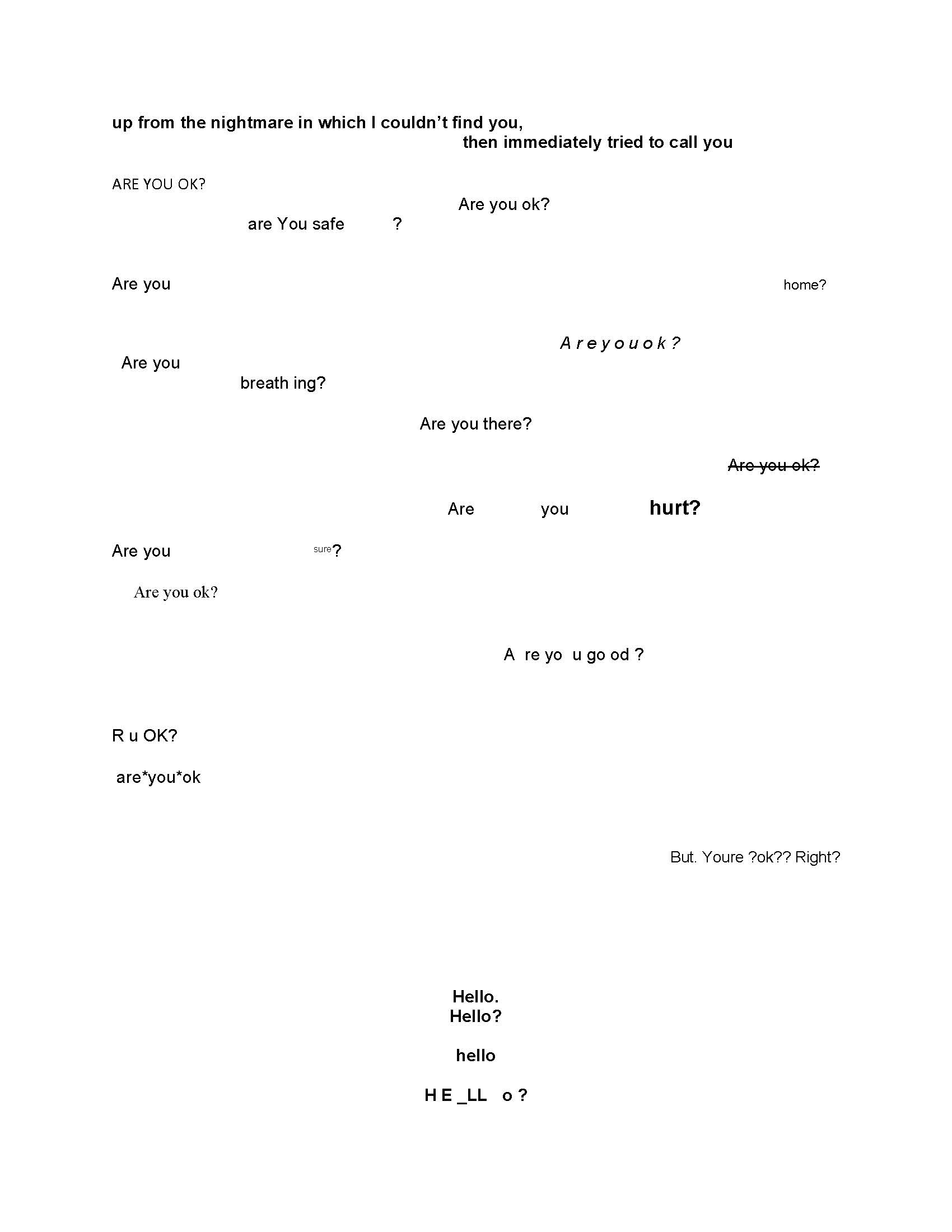
Anastasia K. Gates is a writer, editor, and artist from the Great Appalachian Valley of Pennsylvania. She was awarded the shortlist for the inaugural Oxford Poetry Prize and her work has been published and forthcoming in Only Poems, Tupelo Quarterly, Oxford Poetry, Some Kind of Opening, Counterclock Journal and elsewhere. She earned a Master of Fine Arts in Poetry from Columbia University in the City of New York.
They crowd us from the train and into the chill of the night air. It is again November. There is no light but the light of the moon. She is full and shines through the tangled limbs of barren trees. Move, the officer of the peace grunts, and disoriented you stumble to your knees. Move, he says again, the sound sharper and shriller this time, and you try to get out of his way, but you fall to all fours. Your own shadow prevents you from seeing your hands in front of you, inches from the edge of the platform. The moon has betrayed you by offering your back to his eyes. He kicks you hard in the ribs. You wince as pain crackles electric through you. You hear the bone as it snaps, shards of rib pierce the surrounding tissue. You curse the bitch of the moon. You are weak, weak, weak, so weak, you’re not even that old, and yet you are so weak, he whispers into your ear, his body heat sudden upon you. You are caught, he has you in the posture of an eager, submissive lover. You fight a wave of nausea. You feel his erection as it strains the coarse fabric of his uniform. You eat the image you cannot see. You remember the First War, how the officers were still human then. The boys they sent out into the desert returned, changed. The White Dog disfigured their souls out there, in the expanses of white sand beneath whiter sky. You remember hearing that they went mad as they could no longer distinguish the horizon line and to their eyes all was as blankness and it was then that the White Dog appeared and became their master. You remember hearing the White Dog made them partake of the flesh of their fellows. You remember hearing they died and were not dead. The puncture in your side pulses with the explosive brightness of a dying star. You leak light you cannot see. In ending, everything shimmers. How can you be this weak, he says, his lips wet against your ear, his breath hot and sour. He wraps his right hand around your neck, his hand is so large that it encircles your throat completely, easily. He is such a large man. I could just squeeze and throw you, limp, onto the tracks, his voice resounds as though from deep within your body. The air in your throat is vibrant with constriction. Indeed, the autonomic functions of the body have a terrifying insistence. And just as sudden as he was upon you, his hand is gone and you can no longer sense his presence, his weight and his heat have vanished. You still can’t see your hands in front of you. Minutes pass though they might be ages. You finally think to lower onto your forearms and roll onto your back, safely away from the edge of the platform. You look up into the face of the moon now above the trees. She bathes you gentle in her light. You remember the piano key in your left hand. The last remaining piece of the only thing your mother ever loved.
Bio: Elizabeth Moylan is an artist, writer, and educator based in Brooklyn. She holds a BA in Gender Studies from the University of Chicago, where she also studied Russian Language and Literature, and an MFA in Painting and Drawing from the School of the Art Institute of Chicago, where she was an instructor of painting, print media, and fiber and material studies. She has also taught through the Brooklyn Public Library and been a guest lecturer at the Rhode Island School of Design. She has been a featured reader at Verses in Vinyl at All Blues and will be a featured reader at the Out of the Box reading series at the Bowery Poetry Club on March 11th.
it’s not the crutches we decry / it’s the need to move forward / though we haven’t the strength. This opening line from “Crutches” often plays in my head in a grainy voice with a syrupy sweet pitch. There was a time when this voice would play in the speakers of my 2004 Lexus as I drove from another bratty two year old’s greyly decorated home. These lines were my play, my comfort, and although the speakers of my 2004 Lexus were my favorite place to access them, they squatted themselves into my being the very first time I heard them. Wherever I am, engaging with Nikki Giovanni’s work makes me feel at home.
When I was introduced to Nikki Giovanni’s album, Cotton Candy On A Rainy Day, I was in a lover’s room. Although it wasn’t my own, her voice came on and solidified an intimate familiarity I felt in the space. A prior knowledge of the spirit rather than the mind emerged as I asked about Nikki Giovanni’s life and writing. There was twinkling in my chest, a wash of an oceanic breeze tingling over my body. Because of this auditory introduction to Nikki Giovanni’s work, I am mostly drawn to her voice as well as her words. When reading poems, I often feel like someone is standing over my shoulder and whispering the words onto the page in front of me, particularly when I can relate to what is being drawn up through the crosses and curves. Miss Nikki is who I have this feeling most viscerally with.
After hearing them over and over, mostly in my room and in my car, I read “Crutches” and other poems from Cotton Candy On A Rainy Day aloud to myself. “Crutches” speaks to the emotional bandwidth we all have as humans, the pain that comes with feeling, and the even greater pain that comes with asking for help outside of ourselves to handle the rumblings of the heart. Any person intent on expressing and experiencing their deep feeling will feel seen by Giovanni’s words:
i really want to say something about all of us am i shouting i want you to hear me emotional falls always are the worst and there are no crutches to swing back on
Here she takes the time to scream loudly about something that is usually experienced in quiet, in solitude. She takes the time to place herself amongst “all of us,” declaring that although our pains may be unique, this intensity of feeling is universal. It is within her own comfort in naming the depths of her soul and honoring its rough edges that I am able to feel at home. I am able to feel comfort in feeling.
As a child, I was resistant to feeling emotions like sadness, anxiety, disappointment, rage. As I’ve grown older, I’ve been intentional about letting myself feel these feelings, allowing themto course through my blood with gratitude for the heat. Hearing “Crutches” gives the little girl in me a warm embrace, telling her something she could never quite understand: It is okay to feel. Through this poem and many others, Nikki Giovanni allows me to regain a closeness with myself through her own interiority that serves as a mirror for what we must all face. Her comfort in herself became a place for me to lay a pallet down.
Love, in its ever evolving expansiveness, is a central theme in my work. In diving deeper into Miss Giovanni, I was drawn to poems where she overtly expressed her sexuality, eroticism, and desire, most notably in her collection of Love Poems. It was through poems like “That Day” where she declares: “we can do it on the floor / we can do it on the stair / we can do it on the couch / we can do it in the air” and “Seduction,” where she imagines a scene of her using the power of the erotic to seduce a fellow revolutionary, that I was able to see more possibilities within myself and my own writing. Before Nikki Giovanni’s work, I hadn’t engaged with erotic poems. It was particularly surprising for me to come across erotic poetry by a Black woman writer. With dually sexist and racist figures like Sarah Baartman constantly swirling around my psyche, it took time for me to come to a place of feeling comfort in my sexuality rather than shame. Nikki Giovanni’s firmness in being forthcoming about her sexuality, amidst these negative stereotypes surrounding us, was a sprinkle of encouragement as I went on my own journey to embrace my eroticism rather than hide it. To do so in an artistic medium such as poetry—a practice that is often seen as highbrow—is even more of a statement. She laid a foundation for Black women like me to be in touch with their sexual selves and not allow that embrace to take away from their intellect and active dreams towards the revolution.
Seduction by Nikki Giovanni and untitled (reading with you) by me. Her consciousness is always in my subconscious.
I have a great appreciation for the wandering essence of Nikki Giovanni’s work. Many of her poems feel like a journey. Take “Fascination” for example, where she starts off saying:
finding myself still fascinated by the falls and rapids i nonetheless prefer the streams contained within the bountiful brown shorelines
Giovanni shows us her awe at the natural world, the simple beauties that capture her eye. Within two stanzas, she turns her attention to an unnamed person saying:
my head is always down for i no longer look for you
The awe of the world around her takes her mind to the awe of a special person in her life, an unexpected yet natural curve in the journey of the poem. At the start, one would assume that the poem will continue in the space of nature, but the wires of Giovanni’s mind always want to take us on a wild ride. She continues to speak to her lover while weaving in the atmospheric condition:
i wade from the quiet of your presence into the turbulence of your emotions i have now understood a calm day does not preclude a stormy evening
We are able to see the connections sparking in her mind and go on the ride with her. She gives us room to expand the bounds of what can transpire in a poetic journey. At the end, Giovanni takes us right where we began saying:
if you were a pure bolt of fire cutting the skies i’d touch you risking my life not because i’m brave or strong but because i’m fascinated by what the outcome will be
I love the direct usage of the word “fascinated” in both the beginning and ending of the poem. The middle of the poem zigzags in a way, taking us from one idea and quickly veering into the next, but that word “fascinated” grounds us back into the awe and wonder that we were introduced to from the start. Where the words in the middle of Giovanni’s poems go is usually a mystery to me, but by the end I can feel her palm covering the back of my hand knowing that we have walked along an unforeseen path and transformed together.
The journey she takes us on in a poem almost acts as a mirror for the journey of her life, with many unexpected twists and turns that are still logical within her grand plan. Miss Nikki started her career showing us her anger, her truth, and her allegiance to her people. While that energy certainly didn’t leave her bones, she allowed it to take new shapes. She showed us her rage, but she also showed us her love. Miss Nikki’s work took on many forms—poetry, essays, children’s books, albums—and she lent her knowledge to students directly by becoming an educator. It’s as if she had a few different dialects to choose from when asserting her aliveness and in turn, asserting ours.
In the fall of 2023, I found myself meandering through stacks of poetry at the library: another home for me. I scanned the rows for “G” and was delighted to find a first edition copy of Nikki Giovanni’s debut, Black Feeling Black Talk Black Judgement, asking to be placed in my hands.
The squealing was as internal as I could make it, my twenty-four year old self suddenly turning ten, my breath a wind we hear as we take in the still beauty of an oak from a bench. I hurried to check it out, the corners of my mouth gleaming, my eyes a lake of admiration. Upon cracking the cover open, I was met with the evidence of others’ exploration of Miss Nikki, dating back to the eighties.
In her words, I was most struck by her audacity. At twenty-five—this time capsule of her spirit at the time mirroring my present reality—she did not leave a word unsaid, particularly in “The True Import of Present Dialogue, Black vs. Negro”:
can you kill? a nigger can die we ain’t got to prove we can die we got to prove we can kill
Through her rage towards systems of oppression, she showed the love she had for her community. There lays a pillowsoft beckoning in her words, an open invitation to feel at home in our rightful anger. She knew from age twenty-five that these things had to be let out, written down, and memorialized. This philosophy, which is a central characteristic in her work, is an integral lesson for everyone in the community, especially revolutionary Black folks.
The evolution that comes between my two favorite works from Nikki Giovanni—Black Feeling Black Talk Black Judgement and Cotton Candy on A Rainy Day—is stark. Her first work was extremely militant, looking at the oppressive forces at work outside of her and interrogating its effects. Cotton Candy On A Rainy Day turns her energy inward, interrogating how her own actions/thoughts/beliefs affect her. The militancy is still there almost a decade later, but with a new face. She is intent on confronting herself. Who are militants and activists but deep feeling people unafraid to let their emotions show? The revolution requires changes outside of us, but it also requires a revolutionizing of the self through knowledge and introspection. It was as if she came to know, as she matured, that the revolution had to start with herself, deep feeling and the expression of it the way to get there. She showed us herself so we could have the courage to look at ourselves. She showed us herself so we could become partners in struggle. For Miss Nikki, it was clear that she was always thinking about us as a people, and her “I” within her introspection was one of community, one of oneness. It was important that people felt comfortable being their Black selves alongside other Black people. This cultivation of community serves as another manifestation of home.
As we mourn the recent loss of this poetic giant, lover, revolutionary, and teacher, I am content with the knowledge that she will continue to be a beacon for the people. Nikki Giovanni will continue to speak to us through whispers real and imagined. My everlasting connection to her work will give way for me to feel a comfort in her, through her, and inch closer to an understanding and mastery of the self. She did the hard work of finding home within the bonesshe lived in so we could do the same. I know that wherever her work is, wherever I can access her, I am at home.
Bio: Nicole Alexander is a poetess and educator currently based in NYC. She graduated from Syracuse University in 2020, earning a BA in English and textual studies with a concentration in creative writing. Her recently released, Why I Love Dreaming, is her debut collection of poems.
Poem #3: Espousing bitching indignities in the Crosshairs of Bayard and Baxter Weaseling into the lower ranks Of the General Men, of the General Phalanxes— A horseshoe as admission.
The fallen Babylon being Remnants of those gentrified watering holes Still home to skeletoned Carhartt but Alien to such pale Faces.
Erupting cocks and breasts and all that Has been cut, spliced, or spatchcocked between,
Because eye bags are back! And so are unemployment benefits And so are the slums And so is XXXXX XX XXXX XXXXXXX And so Is that lippy vocal fry And so is Nicorette And so is incest And so is age play And so is pregnancy And so is al that provokes the provocative To deliberate upon these TV-minded Philistines.
Whisper in my ear and Put your tongue back in your fucking throat. Write me something in script, Rhyme to revive Mr. Whitman. Give back the Grandmother her cane.
Bio: Josh Ilano is a New York-Based Writer and Journalist currently pursuing their undergraduate at Pace University. Josh’s poetry and creative nonfiction has been featured in the literary magazine Aphros. They were previously the Arts and Culture editor of the collegiate newspaper The Pace Press, and currently holds a position on their executive board. Independently they publish on their Substack “Dillinger,” and asides from writing, they freelance with Columbia University’s Directing MFA program. Josh aspires to buy their motherproperty in Nebraska one day.
Forgive this island. Its spoiled midnight. Its damp moon. Its black surf, an altar
seducing you. This is your life. Your youth, a goldfish in a glass bowl.
Record the ocean’s rhythmic pulse for your grandmother. Go. Gather the stillness in your fists.
Your hungry limbs. Cage your pulse. Slip into the Pacific. Allow the sharp tooth of the sea
to graze your bare legs. Let Fatima’s gold hand gasp against your neck. Ignore her.
These days, she barely listens to you. These days, she’s less pendant,
more noose. Still, the surf wrinkles under that tart, black sky.
Fashion yourself into a sponge and float like a plank.
There is honor in granting a crisis permission to swallow you whole.
To spit you back out into that chocolate-dipped surf. Kerosene-drum heart.
Curdling in a wet purgatory thousands of miles from home. Imagine your grief inverted.
Your grandmother’s porcelain legs with no sign of shatter.
Stitch them back together with the black thread of your hair.
You’ll try, won’t you?
To recreate that teacup elegance. What’s a holiday you can’t savor?
You, sourpuss. You, spooky and spooked.
Pretend to be weightless. No gravity.
No legs. Just the velvety surf.
inviting you to forget.
Autumn Requiem
Our final October is the alarm clock’s keen. You, with your proud surgeon’s hands, spin a trip as solution. You contort the spine of our Metro-North tickets,
disguise errant jewels of conversation as balm: mulled cider, an unimportant NPR podcast, my father’s birthday. Those hard-earned pebbles of connectivity.
See, we still belong to one another. The stiff wind at Storm King bites our cheeks red. I love you like an earthquake loves its faults.
We trudge to Louise Bourgeois’ Eyes and pose for pictures. We’re from the city, I say, by way of apology. Maple leaves litter the ground: scarlett, orange, yellow.
I envy nature its luscious unburdening: an annual, expected implosion. My pupils inhale the map of your form, counting the years
I have charted. We, overgrown. It’s inevitable: a scalpel dividing the inventory of our lives. The erasure of shared language; the blurry concert tickets,
the bone-white tube of Crest no longer serving two. You still have my copy of Kitchen Confidential, nestled in the wooden crib of your bedside table.
I’ll buy you a Santoku knife in Tokyo, you’d promise. You meant it then. In a past life, who were we to one another? You, a mushroom of salt, dreaming in the Dead Sea.
I, the water, painting your crystals with my tongue: erosion veiled as affection. Nothing survives here, but oh, it was beautiful. How we’ve morphed now:
just two boxers, sheathed in metal, circling the ring: each beginning to mourn the other’s shadow.
Bio: Hailing from Virginia, Insiya Taj is a South-Asian American poet and healthtech professional. For the last decade, New York City has been her home. In August 2024, she was a featured poet for the “Embracing Every Hue” reading series curated by Darius Phelps. She is the winner of Brooklyn Poets’ 2024 Yawp Poem of the Year Contest.
She shuttles in her guts the zoned-out throngs who take for granted the watery caesura from home to work to home immersed in the glow of cellphones while the verdigris torch salutes them.
In this amalgam of steel formed into faux stone, cement and wood, in echos’ echo, passengers shuffle toward seats like atoms. They repel any touch of the coat sleeve, any sidelong look, and they only feel
the glare of a watch at the end of a row, or rapper’s spectacle of neon-pink laces untied to trip on and recover, bouncing to the buzz of earplugs, while the crescent prow glides from the groin of the dockslip.
A barrelled, tan policeman pets his pitbull dazed by the harbor’s glittery plateau— Wall Street trader bedraggled in pinstripes squinches his eyes to blips in the market— and who is this child waving a dollar found
gummed to his shoe? Enter Yankee-hatted homeless who crumple like foil. Enter oil- soiled janitors who slip on gloves for the 5 o’clock shift under the din of passengers debating gas’s rising prices in New Jersey,
New York. How you need a jumbo mortgage to buy a café latté, that this ferry is free!— which ricochet off laminate cabinets clogged with lemon-tinted life vests. We jolt as we dock to a fugue of horns,
and nun kissing a cross before the stampede.
Mrs. Moore on Elizabeth Street
—I am sick of the seam-tight jeans, bleached, blanched the fried voices The NYU students
flitting in the duel of shadows under the scaffolding of Elizabeth Street where boutiques are never
on sale —rushing to shop, to class and some blonde thing cantilevers Cliff Notes over the cliff
of a dumpster drops two used tubes of lip gloss —coral blaze & birthday suit which plump my lips
taste like thrift-shop frosting in Shreveport, 1960 at Aunt Millie’s funeral —the coffin coated in hot-pink
carnations and now designer cakes sell in pricey cafés on Avenue A where a cop thumbs his belt loops
and dreams a bit —he’s my shrink & my shroud, winks & slips me 20 bucks to get him coffee, a donut
& late edition of the Post and I let him rant, for sure how these rich girls will suffer too —brush your gums
pay your taxes —I have a little business selling orphaned heels the girls abandon when they spill out of bars
—mismatched pairs only 50 a pop from my yellow cart and I dress in faux Chanel, of course, and wash at Star-
bucks so nobody thinks “homeless” —a Brand these days without a zip code, tho the City gave me a Box P.O.
but weren’t we all a step in the shoeless exodus from Leviticus to Psalms? I still dream of Aunt Millie,
her sugary picnics, my boy laughing into tatters under a magnolia —my willowy girl preening her gown
swinging like a bell —her name, ‘Marguerite’, a hymn I whisper to bathe me in filaments of sorrow
while Jesus bends blue over shards of my children in the rosary window —and this freshman (no hello)
politely asks if I can find a mate for her blue silk stiletto and I tell her, first, I do have a name. It is Mrs. Moore.
*
Native of Vouliagmeni, GREECE and Martha’s Vineyard, MA., Stelios Mormoris is CEO of SCENT BEAUTY, Inc., which markets beauty products worldwide. Citizen of Greece and the U.S., Stelios was born in New York, and lived most of his adult life in Paris.
He received a B.A. in Architecture from Princeton University, and an M.B.A. from INSEAD [Institut d’Européen d’Administration des Affaires] in Fontainebleau, France.
He has been published in Agni,Beyond Words Literary Review,Book of Lit Matches,Crab Creek Review, Crosswinds Poetry Journal, Eunoia Review, Fourth River,Gargoyle, Good Life Review, High Shelf Press, Humana Obscura, Midwest Poetry Review, Narrative Magazine, Nassau Literary Review, Press,Spillway, Sugar House Review, Tupelo Quarterly, Verse, Whelk Walk Review and other literary journals.
still comes with a piano under his arm but he does not play to avoid disturbing my poems.
Sometimes he brings a canvas, an old brush, vivid memories of red or blue, but he only draws with his black pen,
sitting far from my desk. He does not want the cat he draws from memory to scratch my last stanza.
As much as my father tries, he fails to remain quiet, his unplayed sonata still louder than my words, his cat
still fussing with the brush. I can tell from his long sighs, they are not friends. I suspect they met after he died.
Paper Boats
We’d sail paper boats along a sidewalk curb, after a heavy rain, until they turned again into newspaper pages, moored at the sewer mouth.
Unfulfilled promises turned some of us into resentful sailors, and the weight of reality made the rest of us inconsolable explorers.
When we folded the coarse paper into vessels a filthy puddle was still a river, the muck the water dragged an undiscovered continent.
The Bare Bones of a Fairytale
Once upon a time you are born, and, suddenly, you are a fawn summoned
from your forest, to a far far-away-land where they speak the language of the hunters
you were spared from. Your life becomes about the sound of the breaking of a dry twig,
twitching between being naïve and being alert, pretending to be calm, but still too afraid
to realize you are a young deer able to speak.
*
Juan Pablo Mobili was born in Buenos Aires, and adopted by New York. His poems appeared in Tupelo Quarterly, Hanging Loose Magazine, South Florida Poetry Journal and Louisville Review, among many others in the United States, as well as international publications such as Impspired (UK), Hong Kong Review (Hong Kong, SAR), and The Wild Word (Germany). His work received several nominations for the Pushcart Prize and Best of the Net, and his chapbook, “Contraband,” was published in 2022. He’s also a Guest Editor for The Banyan Review, and currently finishing the manuscript for his next book of poems.
Stella Hayes is the author of two poetry collections, Father Elegies (What Books Press, 2024) and One Strange Country (What Books Press, 2020). She grew up in Brovary, a suburb outside of Kyiv, Ukraine, Chicago, and Los Angeles. Hayes earned an M.F.A. in poetry from NYU, where she taught in the undergraduate creative writing program and served as poetry editor and assistant fiction editor of Washington Square Review. Her work has appeared in Image, Poet Lore,The Poetry Project, Four Way Review, Stanford University Press, and Spillway, among others. Hayes is a contributing editor at Tupelo Quarterly.
Mary Pacifico Curtis writes poetry, memoir and literary criticism, and is the author of Between Rooms(2016) and The White Tree Quartet (2018) and a memoir, Understanding Moonseed (2022). She has had a Silicon Valley career in PR and branding, and as an entrepreneur and VC. Mary lives with her husband, two dogs and wildlife that share their terraced California home. Her first full length poetry collection, Hawk’s Cry, was published in 2023 by Finishing Line Press.
At the train station in Córdoba, we rented an aging Gray Renault and drove to the mountains, the car’s Maintenance light flashing red the whole time. From both sides of the road, rows of olive trees Extended their camouflaged limbs, saluting The afternoon sun, while small rivers carried Dust and run-off to the south. On the hill above Almodóvar del Río, the towers Of a castle, mirage-like, stood without blinking. The highway pointed north, and the engine strained Until I shifted to a lower gear. Then—again, On both sides of the road—there were orange groves, White flowers and early fruit, the scent Of oranges all around us and inside Our rented car.
In Puebla de los Infantes, lunch was almost over When we found a parking space on a street Cut into the side of a hill, a row of cars perched At 45 degrees, brakes firmly engaged. One restaurant was still open. We ate Quickly—Ximena’s reading was in less than An hour. ¿Dónde está la biblioteca, por favor? “Drive down the hill and ask someone else,” two Andalusian ladies replied. By chance, we saw The sign, and a man exercising a brown Stallion by the parking lot. Ximena read well, Poems about her country, her parents, our life In Miami. The crowd was happy to hear her. She’d come all the way from Colombia, where There are also mountains, but instead of olive Trees and oranges, there are mangoes and bananas, Guerrillas and paramilitaries. Another poet gave her a copy of his book, and We drove back to Córdoba in the dark. I stopped at a gas station to buy bananas And oranges.
Reading the Classics
There was a used bookstore just above 86th Street—I don’t remember The name—where I overheard someone Say the Greeks had no word for “success.” It was at a time in my life when I didn’t feel particularly Successful. My marriage had become (Don’t lie—it always had been) a string Of ugly fights. Each time, we wondered If the words we’d said meant there was no Going back, no forgetting this was What we both really felt. The people Who lived above us would comment through The ventilation shafts, imitate Our insults and laugh. They also liked To play songs from Camelot and sing Along. The woman next door received Visitors, men who strangely brought bags Of groceries. She’d put on music With a loud bass, and I’d see them leave Later when I went to walk the dog. Her boyfriend waited outside, either Sitting on the steps or in his car. Eventually, they moved, and a Korean family who’d bought the Bodega on Columbus moved in. I started taking Greek classes at The New School. I remember the sun Setting on Fifth Avenue in the Summer, neon lights of restaurants And bars, moments when the streets emptied, When it felt good to walk to the class Where we’d translate some lines of Plato, Heraclitus, or Sophocles, and Nobody mentioned the word “success.”
A Doppelgänger
Ere Babylon was dust The magus Zoroaster, my dead child, Met his own image walking in the garden. Shelly, Prometheus Unbound
Borges met his younger self on a park bench In Geneva. Or, it might have been his older self; These things are hard to figure out. I had A doppelgänger also, but not me at a different age. I discovered him when I gave a reading once At a bar in Boston. Some people showed up Expecting him and left when they realized Their mistake. We never met, but I’ve seen His picture. He had those long sideburns they Call “mutton chops” that were popular back In the 70s. Sometimes, friends mistake his books For mine, at least one book of poetry and a work, I believe, on Eastern religious practices. He Traveled to India for sure, while I only know Asia from museums. I suspect he was the more Intelligent of the two of us. He could read Sanskrit like Eliot, but I don’t know his poems. I avoided Them on purpose, afraid I’d meet myself, with Whatever consequence that might entail. It’s generally bad news to encounter your Other self. Still, a few nights ago, I read online That he’d died last year. I had to look away From the screen. He wasn’t that much older Than I am. Now, the only chance we’ll have To meet will be on a park bench by Lake Geneva Or walking in a garden in Babylon.
*
George Franklin is the author of seven poetry collections, including his recent: What the Angel Saw, What the Saint Refused from Sheila-Na-Gig Editions. Individual poems have been published in Matter Monthly, Solstice, South Florida Poetry Journal, Rattle, Cagibi, New Ohio Review, The Threepenny Review, The Comstock Review, One Art, and Cultural Daily. He practices law in Miami, is a translations editor for Cagibi and a guest editor for Sheila-Na-Gig Online, teaches poetry workshops in Florida prisons, and co-translated, along with the author, Ximena Gómez’s Último día/Last Day. In 2023, he was the first prize winner of the W.B. Yeats Poetry Prize, and his work has been featured on the public radio podcast The Slowdown. His website: https://gsfranklin.com/