Wettest On Record

S/he did not go by bus.
S/he did not leave by train.

The sad horses are still
tethered downtown, their antique
trough for sale. For the centennial,
the sad horses will cue the parades,
the throngs of hamfisted officers.
********The bit, bone against.
********Taste of it? Metal
********like blood, of course,
********or a warm body, or
********a plush equivalent.

Here, we have mostly only known the donkey.
Or the zoo, lumps of
orangutans pressed against
glass hide against
glass peel hide
off glass. Or that bit about brutes, cereal boxes and sunday cartoons.
Ride away into the poster sunset.

The teller put two fingers under
his chin and in forming the L with his thumb
says thank you.

In dream: a Spanish church—Saint
Victoria—at the top of two thousand stairs.
An elm, pedagogical in its lean.
********(acid blue
********leaf work
********of elms)
The students were waiting, lined
against an old world wall.
Number One was waiting, “patiently,”
they said. Patiently like leaf work’s cut
into acid blue sky, like the flood’s work
on a ribboned trunk. There, Number One
points, was the year of my birth.

The inaugural lecture is posted on Victoria’s door.

Brimming vat, long walk, prostrate light: lightbulb
slate light of the northerly storm. First the wind,
as if motion harbinged wet **** dark **** portrait flash.
I am empty full up, the students chant.

*

Emma Train is a poet from Berkeley, California. A graduate of UC Davis’s MFA program in creative writing, she is a PhD candidate at the University of Texas at Austin, where she is writing her dissertation on contemporary queer ecopoetics. Her poetry has appeared, or is forthcoming, in the Berkeley Poetry Review, the Colorado Review, Grist, and Interim. She was most recently a finalist for the 2020 Omnidawn Open Book Prize and a finalist for Interim’s 2020 Test Site Poetry Series.

Hymn

The fire has jumped the river limned with redwoods

Baptismal font, ball bearing
beam. Last year he
asked where he could
swim around here, here
the beaches are
all washed. I told him there
is the pacific ten
miles downstream and
the estuary is shallow.

The diablo winds have risen. The fire
is here like a second
coming they are all
saying come, come
quick the fire has
jumped the four-lane
highway, the oak
groves, the chaparral.

But I have yet
to matriculate
into a self. The project
of it all, the missing
desperation, mapping
the rate of smolder,
until it’s not we
don’t see what’s here.
We had all the right
tools: the shovel
for the well. The pick-
axe for the wall,

the pick for the lock;
we were shiny, new, the
river limned with
children.

Things are burning,
the approaching trot. This life
someone said is easy.
The fire has jumped the river.

Only life and another is a
catastrophe,
that sanctuary.

*

Emma Train is a poet from Berkeley, California. A graduate of UC Davis’s MFA program in creative writing, she is a PhD candidate at the University of Texas at Austin, where she is writing her dissertation on contemporary queer ecopoetics. Her poetry has appeared, or is forthcoming, in the Berkeley Poetry Review, the Colorado Review, Grist, and Interim. She was most recently a finalist for the 2020 Omnidawn Open Book Prize and a finalist for Interim’s 2020 Test Site Poetry Series.

The News (For Lack Of What Is Found There)

Cockroach enamors              a forgiving door
Where’s your cord to history?
Desk’s weight, that
grand canyon. Only so much sitting
so much of the eponymous brown
bag. I’ve been unruly,
lost the keys (the frosted glass
neighbors don’t peak)

Highway, behind a car with lost letters:
CAPITAL SUBURB
Precise, correct, like
****************a boat on water

Look, it’s trash day again and
the wind gropes cool

Birds are named out the sky
****************(the manly thing to do)
Family tree hangs on the fridge, waiting or amended

I’ve lost all the pictures of the family jewels
Mistakes are laid
********down like forks

I’m sorry. You’re spring
****************loaded                     You ask why we should eat
when there’s fire
Eat me please               please
please eat me but where are your edges?

Here the yardstick is king
Haven’t you all heard the expression
a forest can’t hide crouched behind trees

Please tide us over or
tide out the wreck because
the bronze men are removed by night
hardhats and the city is content
this is not the kind of nation where
every town has a square
and every square a wall
of names

No matter how far we drive into
the hills we are
always on the edge
of a bad neighborhood

Rows of young lavender
are planted in black bark
and the last string
of lights is unwrapped from
the maple tree, top to bottom

The cliché is ‘raised by
wolves’                  Not raised, but
suckled, not wolf but
she-wolf

Ask what regrets

*

Emma Train is a poet from Berkeley, California. A graduate of UC Davis’s MFA program in creative writing, she is a PhD candidate at the University of Texas at Austin, where she is writing her dissertation on contemporary queer ecopoetics. Her poetry has appeared, or is forthcoming, in the Berkeley Poetry Review, the Colorado Review, Grist, and Interim. She was most recently a finalist for the 2020 Omnidawn Open Book Prize and a finalist for Interim’s 2020 Test Site Poetry Series.

Review: Glyph: Graphic Poetry = Trans. Sensory by Naoko Fujimoto

Glyph: Graphic Poetry = Trans. Sensory, by Naoko Fujimoto. Tupelo Press, 2021. 54 pages. ISBN: 9781946482525 (softcover). $21.95.


Sad to say, most artists, when they set out to “think outside the box,” instantly think themselves into some other box. If we can say the intended effect is that of a jack-in-the-box, the actual achievement is usually more like what you get with a Slinky: same exact metal coil, different (and lower) step.


It’s hard, clearing one’s mind of the assumptions governing genre. It means distrusting what one is accustomed to calling one’s taste. Instead, one seeks to pass legislation (in one’s spirit) making something legal that was hitherto, at best, frowned upon—and, at worst, hunted to extinction.


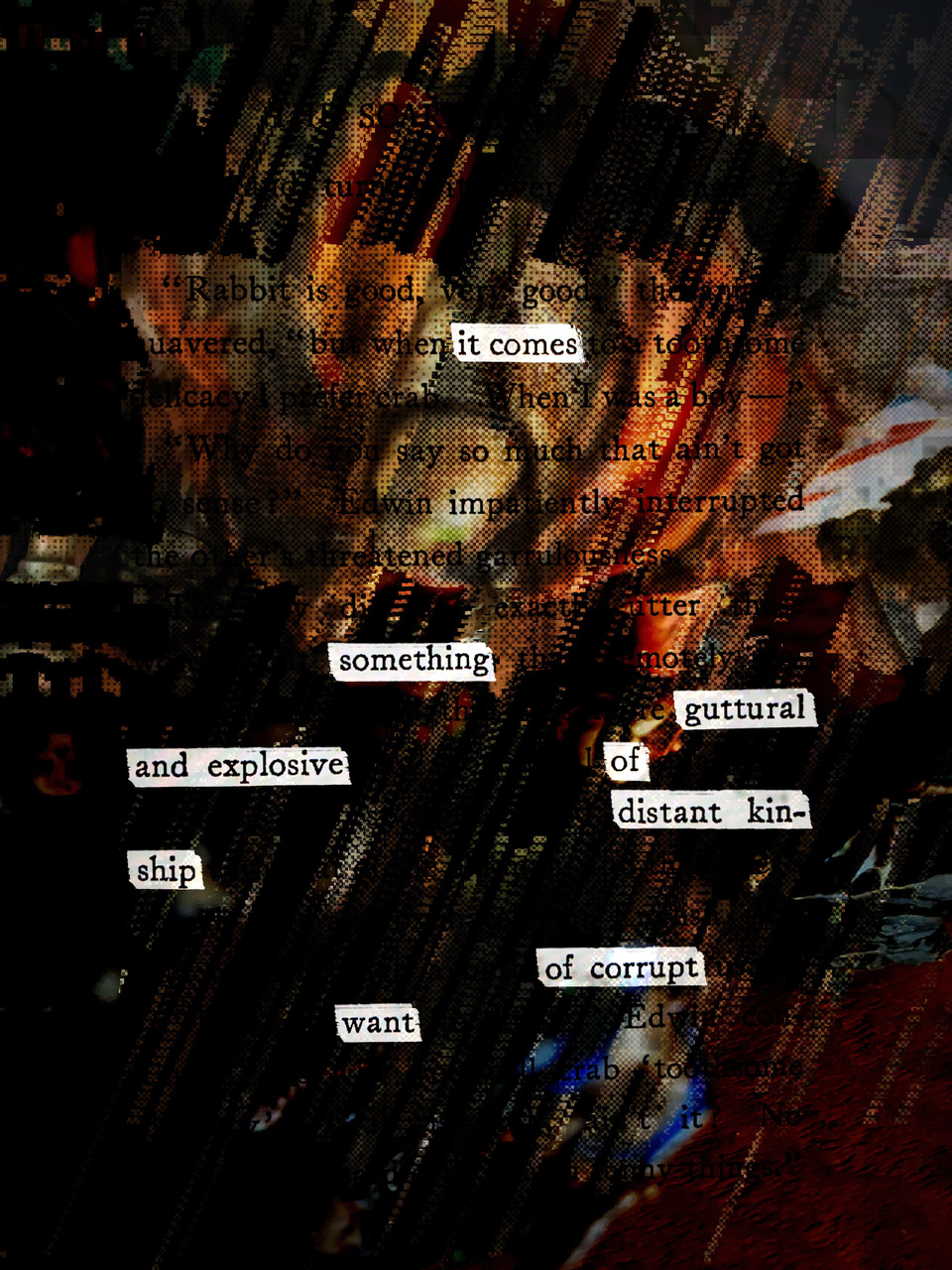
The book under review is what happens when, by genius or luck, things work out. The risk is taken, an ocean of effort is expended, and something explodes out of the top of the box, a thing that did not seem like it could even be in there at all.


You have to understand what a graphic poem even is. The usual Slinky is the “illustrated poem”—a normal poem that could easily stand on its own, accompanied by a picture or series of pictures. Nothing wrong with this! But it’s familiar. It’s really not a new kind of poem; it’s the old kind of poem with “a li’l something extra.” The words of the poemprompt the picture. They are not part of it.


An instructive comparison can be made to the graphic work of Kenneth Patchen. That stuff is wonderful, but even when it is at its most wild, it is fundamentally cartoon work. You don’t doubt for a second that the words precede the images.


Whereas! if one were to set out to make words part and parcel of the images—if {“words”} could legitimately be added to the list of items specifying the “mixed media” that went into making the work (“pen and ink, colored pencil, magazine cutouts, words, sentences, sheet music, water color,” etc)—then you’d have a real crisis. The implicit demotion of the verbal aspect goes against many people’s taste/assumptions/cardboard walls. Many will not give that kind of graphic poem a chance. But in the present case, they’ll miss out on something good.


Fujimoto’s pages erupt with colors. There are bold, Matisse-like shapes, futuristic stripes, girlish drawings, upside-down words and images, secret themes and negotiations being pursued in the background, in the foreground, in the textures. The aesthetic is very busy.


In order to keep the words from taking over, they are not allowed to gain any momentum. Lots of fragments—and, when there are sentences, they’re in a more-or-less flat affect. Declarative statements, laconic. They’re not made to be quoted, and indeed quoting them would be misleading. The way to look at these pieces is not to readthem; you have to gaze at the work and wander around in it.


The book format is not ideal for this kind of thing, by the way. But it’s a necessary evil. The ideal thing would be to have your favorite of these pieces hanging on the wall by your desk, so that every time you look up, every time you give way to reverie, every time you’re hunting for a word or image for your own work, you could consult with the piece hanging there. Whereas, in a book, the temptation is too great to turn the pages and see everything the artist has to offer all at once. Then you miss everything.


In the spirit of what I just said, I’m going to include exactly one image here. I suggest you screen-shot it and keep it on your “desktop” for a while. If you find the experience satisfactory, the book is only twenty-two dollars. There’s enough stuff here (forty-five discrete items) to keep you in a very special state for a decade. Just go slow, please. Slow.

*

Anthony Madrid lives in Victoria, Texas. His poems have appeared in Best American PoetryBoston ReviewFenceHarvard ReviewLana TurnerLIT, and Poetry. He is the author of I Am Your Slave Now Do What I Say (Canarium, 2012) and Try Never (Canarium, 2017). He also did a “children’s book for adults,” called There Was an Old Man with a Springbok (Prelude Books, 2019). Website at www.anthonymadrid.net.

On The Map Of The Neighborhood

I swam over roads as the trapped rains rose. My allegiance to lines: even as the pavement distorted under refractions of cloud-light through brackish waters. By midnight only chimneys remained above water. I slept perched, one lid open, one closed. I dreamt of being in a car driving swiftly west, of finding a wall and climbing it. After the wall, there were mountains, owned by no state, claimed by no god, but to scale them, I had to strap on crampons. I tethered rope through my belt straps. The climb took all night. When I reached the side where there was no god and there were no rains, I woke on my own chimney, lifted both eyelids, surveyed the muddy waters by dawn-light. Why bother? I floated East on my back, hung above the park so I could swim out of lanes. That night, awake on the precipice of the next storm, a tree floated by me glowing green and yellow. I grabbed at its branches. Together, we floated North, where rooted evergreens peeked above the water. We collided into one, so I rested, ran my hands over the lights of the glowing tree I had swam with. The lights were mushrooms, and I was hungry, so I ate them, then waited on my fingers to turn green, orange, to ignite, but instead I grew very sick in the dark. In the limbs of an evergreen, in the dark, I dreamt the peak of a mountain, roped, I dreamt the edge of a gate, a border, a fence. I drew a map of the neighborhood, traced the lines with my luciferin tongue. The edges glowed.

*

Aimee Wright Clow is a writer and book designer living in Durham, NC, where she co-curates the Octopod Poetry & Music Series. Her book arts project, A Brief Map of Albany, is available from Utilities Included. aimeewrightclow.com

The Mandarins

We sleep in a red velvet room the novel drew up, and at breakfast there are fourteen people at the table having toast and chicory tea. Swallow the heat that steams, practicing speech. We’ve forgotten how to narrate more than ourselves, but it’s okay, the meal’s over. All the chairs shift and scuff. Here’s a revolution to believe in. Behind the velvet curtains you have hung the stocks and barrels, locked. I see no reason to learn to aim them. The guests move into the living room and light a fire. One tells a joke. Two name myths. The fourteenth has a plan for us to step into. This is a party, remember: Joy. I weigh the heat outside my skin, sip tea, the heat inside me. As the fire dwindles, the guests exit stage left, so it is only you and me at the oak table for lunch. We eat sandwiches and reminisce a time when we were always alone, then I clear the table, while you fondle curtains, take down a gun and aim it at the window. I read you passages from the novel, about Paula, how she could have sung but chose not to; about Nadine, who tried to grow up but smeared the charcoal under her eyes; about all the men at bars speaking the conditions and conceits of war. You lock the barrel to the wall. Out the window, the street is pavement, it is raining, all the pit bull puppies thrash at their fences. Yes, I know what will change, only nothing has happened yet. Yes, we light candles, untie ribbons, cover the windows. You open the book. I finger the locks. We speak belief, and it is only a word.

*

Aimee Wright Clow is a writer and book designer living in Durham, NC, where she co-curates the Octopod Poetry & Music Series. Her book arts project, A Brief Map of Albany, is available from Utilities Included. aimeewrightclow.com

background

I consent to release the necessary information to determine my eligibility for the Low-Income Housing Tax Credit Program. I understand that providing false information or making false statements may be grounds for the denial of my application. I also understand that such action may result in criminal penalties.

     we use gut        (to keep living)        to mean taking        (in my home)        something out
         what we are            (i fill)            taking out            (out the paper)            are guts
guts separate  (to prove i don’t)  what our bodies need   (have money) from what we cannot use
 when gutted   (sign a waver)   guts separate   (for the damage)   from the body that needs them
name this    (i may incur)    a thing    (from their official fingers)    after what it does not have

(rooting through my guts) Applicant hereby (hunting for unclaimed
pennies)       authorizes management        (to cut my children with)   
to verify above information   (dumping unlabeled organs)   and make
independent investigations in person, by mail, phone, fax, or otherwise  
(in the shredder)  to determine Applicant’s rental, credit, financial,
and character standing  (tell me it is necessary) Applicant releases
management (is fraud prevention) from any liability whatsoever       
(to catch me)  concerning the release or use of said information  (in a
deficit) and will defend and hold them all harmless (of deserving)
from any suit                        (name this body)             or reprisal

                        (this body’s human services)

                                                           guts is a way

                                                 (a thing)

                                                           of saying the courage

                                           (after what)

                                                            it takes to keep living 

                                   (it does not have)

*

Jessica Lawson (she/her/hers) is Denver-based writer, teacher, and queer single parent. She is the author of Gash Atlas, winner of the Kore Press Institute Poetry Prize, and the chapbook Rot Contracts (Trouble Department 2020). A Pushcart-nominated poet, her work has appeared in The Rumpus; Entropy; Dreginald; Yes, Poetry; The Wanderer; Cosmonauts Avenue; and elsewhere. 

Plastic Rose

Refined, cracked and catalyzed
on the other side.

Resined-hardened-nurdled-
colored and cast.

How she buzzes while watering her rose.
Does she expect me to bloom too?

Honey, I don’t say, while resin and glue
I’m no less due.

But all I can do is look true
as tears roll down my stem.

*

Kenton K. Yee has placed poetry most recently in Ligeia Magazine, Plume Poetry and Summerset Review, among others. An Iowa Summer Poetry Workshop alum, he’s a member of the Attic Institute for Literary Arts. Kenton makes his home in northern California.

Corporate Life

Beyond the walls
a thousand sandals clap.

Mount Vesuvius rumbles
not far away.

We feel the heat of the lava
but can’t outrun it.

Larva shall eat our burnt bodies,
leaving molds for posterity.

No telling who will care
to cast our plasters.

*

Kenton K. Yee has placed poetry most recently in Ligeia Magazine, Plume Poetry and Summerset Review, among others. An Iowa Summer Poetry Workshop alum, he’s a member of the Attic Institute for Literary Arts. Kenton makes his home in northern California.

The Spiders

Broomfield, CO

I put my face in

************************webs
************************my hands

****************************************hours and hours

************************Blank

************************in the mirror it is my
                   *******              face it is not my

face                 *****            is                                                          is not

********my palm loiters on the counter above
       **     the tampon box in the drawer
               *****                     that goes

*****                                    thunk

Just leave them I said to him
but a man comes and sprays

                                                our limens
                                                                                    again

                                                cellar spiders
*******************************dangle and hurry

************************he says these webs                 hand scything through the air
************************he sends me to the
************************community office                   
*******************************************************again

I          

                                                How can we help you?

**************************************************************************am

****************I mumble through
****************silk threads my fingers
************************I’m sorry it’s the spiders         again

********************************we’ll send another man to spray them

now he wants

************************Resist             

******                                    { my head goes                                                                                                           thunk }

********I wake in the meat department
                        styrofoam snow
                        vermillion
****************with bloody beef
****************above in the mirror
****************it is my

face?                                                                it is not

my face                                   is                                                          is not

            vermillion
bloody beef
********vermillion

he grabs my arm

********************************my brain goes

********************************thunk  

                        I wake in the pickup

                                    leaving the Costco parking lot

I wasn’t asleep I returned

****************************************************************from the mirror?

                                    I am                                         am not

                                                            He wants

            Pizza

My brain goes             thunk               bloody beef

My brain goes             thunk  

                                                            bloody beef

He says he wants

Pizza

            I wake up on the couch

************************in front of the tv

I wasn’t asleep I returned

***************************************************************from the kitchen?

                                    I am                            

************************Blank

a cheesy ad                                                                             for green card lawyers
he says                                                                                     let’s rip up your passport

My brain goes             thunk

                                    bloody beef

sure I say I have to pee

                        he’s eating pizza

                                                                                    I take off my slippers
                                                                        I take off my socks
                                                I pull my socks over my fingers
                                    so when I take my passport
                        from his dresser drawer
            it doesn’t go

thunk

              I hover over the toilet seat
****************I pull my socks off my fingers
********                        I drop my pants and squat
********************************hurrying a spider
****************************************behind the bowl
                                                                        I put on my socks
********************************************************I put on my slippers

********I hide my passport in the tampon box
********    slide the drawer quietly closed
****************so he doesn’t hear it

************************thunk

*

Kayla Geitzler is from Moncton, within Siknikt of the Mi’kma’ki, the traditional territory of the Mi’kmaq People (New Brunswick). Named “A Rad Woman of Canadian Poetry” by All Lit Up, she is Moncton’s inaugural Anglophone Poet Laureate. Her first book That Light Feeling Under Your Feet was a Calgary Bestseller & finalist for two poetry awards. Kayla is co-editor of Cadence Voix Feminines Female Voices (Frog Hollow Press 2020), the first publication of its kind in her province. Host of the Attic Owl Reading Series and Writing Life columnist for The Miramichi Reader, Kayla holds an MA in English Creative Writing. She works as an editor & writing consultant. Kayla’s writing has appeared in The FiddleheadGnaw & GnarlThirteen: New Collected Poems from LGBTQI2S Writers in CanadaPoetry Is DeadThe Antigonish Review, Chutes Reversibles 2, as well as in other Canadian literary publications.