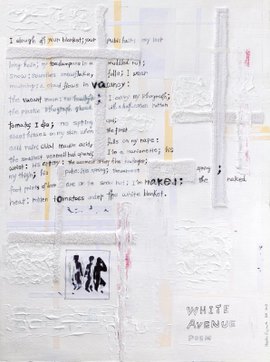
And

You and I go together like the ampersand symbol and the number 7 key. Maybe that placement is why I consider ampersands lucky.

Was it Mom or was it Granny who taught me that when a street sign or telephone pole or person passes between two walking shoulder to shoulder, always say “bread and butter” as a form of reunion on the other side?

O coordinating conjunction of revolutionary parity! Joining two or more clauses of equal rank!

Perhaps I like pub trivia for its exquisite purity, an elegant realm where facts are facts, evaluated only by the metrics “right” and “wrong.”

Some things I don’t mind taking jointly: Ice cream and cake. Wait and see. Whereas I’ll take the pens and leave the pencils, take the potatoes and leave the meat.

Yesterday I decided to go for a run, and then I tripped and broke my hand. Would that I could eliminate that second and third and but I can’t. In one instant I was a person who had lived 41 years with no broken bones and the next I was struggling to stand and walk home.

Is it acceptable to begin a sentence with and? And how! Though prejudice lingers from a bygone time.

He used to be so handsome, and now…

Those personality tests like the Meyers-Briggs can be deceptively encouraging of binaries—much more either/or than and. I’m an ENFJ, but the extraversion rests on the slightest majority, hovering between 51 and 53%. Whatever kind of vert you are, I will probably like hanging out with you.

Ecosystems and continuums. And so on. And so forth.

Physicist Max Tegmark argues that time is an illusion brought on by perception, not something fundamental to the universe. “We can portray our reality as either a three-dimensional place where stuff happens over time, or as a four-dimensional place where nothing happens—and if it really is the second picture, then change really is an illusion, because there’s nothing that’s changing; it’s all just there—past, present, future.”

A poet I follow on Twitter used the bottom of her coffee mug to make a Venn diagram: Radical acceptance and compassion vs. fuck around and find out.

What Tegmark means is that “life is like a movie, and space-time is like the DVD” where “nothing about the DVD itself that is changing in any way, even though there’s all this drama unfolding in the movie.” In that sense, I am always a) about to break my hand and b) breaking my hand and c) walking around with a broken hand simultaneously. Interesting concept, but I still have to get surgery to put two pins in my finger this Wednesday.

I like being a person alone in a room and I like being in expansive company.

Little kids intuitively grasp the improv-troupe credo of Yes, and. Like if you say “We’re playing store,” they’re like “Yes, and these birch leaves are the money.”

The plot twists and turns like a surgeon’s scalpel.

***

Kathleen Rooney is a founding editor of Rose Metal Press, a founding member of Poems While You Wait, and the author, most recently, of the novels Lillian Boxfish Takes a Walk (St. Martin’s, 2017) and Cher Ami and Major Whittlesey (Penguin, 2020). Her poems have appeared in Poetry, the Atlantic, the North American Review and elsewhere, and her latest collection Where Are the Snows, winner of the XJ Kennedy Prize, is coming out from Texas Review Press in Fall 2022.  She teaches at DePaul and her next novel, From Dust to Stardust, will be published by Lake Union Press in Fall of 2023. 
Arms

I’m feeling downwardly mobile, please hold me in your arms.

A human upper limb from forearm to wrist. Body part most associated with power and might. The long arm of the law. The logistical arm of the Air Force.

O bitter airborne struggle over the armrest on a plane!

I don’t like being held at arm’s length, especially when the holder has exceptionally long arms.

An arm is the foreleg of a four-footed animal. Would human hunters be so excited about the right to bear arms if the law also extended the right to arm bears?

Arm in arm is a comforting if inefficient way to walk.

Few people look attractive with a sweatshirt tied by the arms around their waist, but some look okay with a sweater draped over their shoulders like a prep school kid or a sweet old man or Carlton on The Fresh Prince of Bel-Air.

I’ve never stood arms akimbo, studying the family coat of arms, but I often sit back and wrap my arms around my knees.

America has more guns than people, an absurdity that could make you weep: everybody on the street potentially armed and dangerous. Even babes in arms just armed to the teeth. The cost of going to the store could be a literal arm and a leg if somebody chooses to shoot it up.

Do I only find the sexiness of bare arms with tan lines unerring because I was a child in the 80s?

Lay down your arms. Really, lay them down and tuck them in neatly. Read them a bedtime story, sing them a song, tell them good night, and bid them sweet dreams.

Is scary-cute the rarest form of cute? A big old T. Rex with 60 teeth, each eight inches long, and two itty-bitty arms.

To furnish or equip with weapons? No thanks. But to arm citizens with the right to vote? Yes, please. All world leaders who want to hold arms races should instead resort to arm wrestling at most.

Repeal the Second Amendment already.

The fashion these days is to denigrate Hemingway as hopelessly macho, but A Farewell to Arms holds up. I admire the way he struggled with the ending especially, rewriting it by his count at least 39 times.

I like to say of my nephew sometimes, “Get a load of the arm on that kid!” when he throws a ball, but honestly, he’s a lot better at soccer.

My favorite memory of you is when you crossed your arms and said, “Let me show you how to set a boundary with an asshole.”

God takes the dead into his arms and sorts them out.

My new strategy: I welcome existential dread with open arms, I ask it to coffee, I get in its head. I make it my friend.

***

Kathleen Rooney is a founding editor of Rose Metal Press, a founding member of Poems While You Wait, and the author, most recently, of the novels Lillian Boxfish Takes a Walk (St. Martin’s, 2017) and Cher Ami and Major Whittlesey (Penguin, 2020). Her poems have appeared in Poetry, the Atlantic, the North American Review and elsewhere, and her latest collection Where Are the Snows, winner of the XJ Kennedy Prize, is coming out from Texas Review Press in Fall 2022.  She teaches at DePaul and her next novel, From Dust to Stardust, will be published by Lake Union Press in Fall of 2023. 
Voyagers

Today in the taxi I was thankful for all the near misses and sudden stops, times I nearly died or almost nearly.

I wondered about the raccoon I saw on Central Park North, rooting through a garbage can. Could this have been the Lord wading through the black molasses of night, and how many years will Her wandering go on?

***

Sean Singer is the author of Discography (Yale University Press, 2002), winner of the Yale Series of Younger Poets Prize, selected by W.S. Merwin, and the Norma Farber First Book Award from the Poetry Society of America; Honey & Smoke (Eyewear Publishing, 2015); and Today in the Taxi (Tupelo Press, 2022). He runs a manuscript consultation service at www.seansingerpoetry.com

An Imperfect Glass

Today in the taxi I picked up this guy on the Upper East Side, and he wanted to go to Spring Street and Washington Street. He had a blue ice pack on his head.

I crossed the park to Broadway to the West Side Highway to Clarkson Street to his address. For 20 minutes, he was yelling about the traffic, though it was light, as his intensity continued.

I wondered if his wound was self-inflicted, an accident, or something else. I could see how he might make a person lose their composure.

After a while driving eight hours a day, the driver and the car become one. It is not unlike being a person—moving forward on a one-way that is irreversible and pre-determined. I instinctively compute the spaces around the car and move faster—mirror in the mirror—then only briefly letting my eyes meet his eyes.

***

Sean Singer is the author of Discography (Yale University Press, 2002), winner of the Yale Series of Younger Poets Prize, selected by W.S. Merwin, and the Norma Farber First Book Award from the Poetry Society of America; Honey & Smoke (Eyewear Publishing, 2015); and Today in the Taxi (Tupelo Press, 2022). He runs a manuscript consultation service at www.seansingerpoetry.com

Like the Biologists,

I thought
the ghost orchid’s labellum

split into lateral
tendrils so the giant

sphinx moth would land
between them, its twelve-

inch tongue designed to suck
from a twelve-inch

tube. But stalking the magic
of long, open legs

with help from light
and camera traps revealed

encounters I didn’t know
existed. I can watch

the fig, streaked, pawpaw
or giant sphinx hover, probe,

and pollinate the ghost.

***

Beth McDermott is the author Figure 1 (Pine Row Press, 2022), and How to Leave a Farmhouse, a chapbook published by Porkbelly Press. Her poetry appears in Pine RowTupelo QuarterlyMatter, and Jet Fuel Review. Reviews appear in American Book ReviewAfter the ArtKenyon Review Online, and The Bind. She’s an Assistant Professor of English at the University of St. Francis and recipient of a 2020-2021 Distinguished Teaching Award.

Ride

Is it stupid to declare I’m hopelessly devoted
when my beliefs always come full

circle? One minute I defend you, the next
I’m riding in a Ferris Wheel gondola, correlating

my shifting perspective with the shift
in my apparent weight. When I feel buoyant,

you’re a chit, tile, chip, token, peg, meeple or
marker—a game piece I can push

around the board. I’m the centripetal force
that constrains you to the path of least

resistance, until I slow like the first
wheel dynamited into scrap.

***

Beth McDermott is the author Figure 1 (Pine Row Press, 2022), and How to Leave a Farmhouse, a chapbook published by Porkbelly Press. Her poetry appears in Pine RowTupelo QuarterlyMatter, and Jet Fuel Review. Reviews appear in American Book ReviewAfter the ArtKenyon Review Online, and The Bind. She’s an Assistant Professor of English at the University of St. Francis and recipient of a 2020-2021 Distinguished Teaching Award.

Minutes Overheard from The Vagueness Society Holiday Party

NYU Philosophy Department, 1998

Someone is always here to misunderstand us.
This is not the only matter set forth we can save.
No side-step just for moonful eyes, nor blindness
of horses, nor a train’s length between sidelong roads.
This is a fugue. We must detail side roads now,
take out the Phrygian mode from our waters.
Truth-values might not be for everybody, but
we can still absolutely hang out here—
hideous, muck-licked against the fake wood walls.
For lo, fellow members, every day is a challenge, we guess.
We were never in the right place or in the right drama.
Someone was always here standing still and said
how we looked like we knew what we were doing.
Blink your eyes and a heap is a non-heap.
Blink your eyes and it’s a whole decade and change.
And we would never open their mail.
Their problems are nasty. We dreamt about it, lost it,
forgot it, winced. For we are the most important problem
on Bullshit Row. Anyone next to us looks just like us
with just a little change, and right on down the line until
we are unrecognizable, freaks with our heads cut off. 
One must stand up to the villains of certainty and,
in our dotage, we will be paid well to be cranky.
Our sand-heap counsel stays in cages. Blink your eyes
and, generally, vagueness is actually useful. As for the cake:
we didn’t eat anything that didn’t say it was food before we ate it.

***

Daniel Nester is the author most recently of Harsh Realm: My 1990s, a collection of poetry and prose poems from Indolent Books. His work has appeared in New York Times, Buzzfeed, The Atlantic, The American Poetry Review, The Best American Poetry, Bennington Review, The Hopkins Review, Word For/Word, Court Green, Love’s Executive Order, and other places. He is the editor of Pine Hills Review.

Future Days

Live, Throwing Copper (1994)

That one time no one showed up for a poetry reading
I hosted, that one event replays over again up here in Albany,
where no one shows up to any poetry readings anyway
and where the only station my AM radio gets
loud and clear is “Catholic words of peace and glory.”
I camp out at the second-string coffee place with high windows
like the Brooklyn bookstore where no one showed up
to the poetry reading. The poets came, sure. They always do.
But no one else did. The poets blamed it on Charles Bernstein’s wife,
who had an art opening. Which would’ve made sense,
but it was in another borough and on another day. 
The poets were Canadian, and complained about their
small travel grants. I bought them drinks. Today,
in the second-string coffee place filled with high windows,
undergrads talk about god and test scores, and I spot
a grad student I know, his face in Williams’ prose.
He’s wrestled with him for years now, says it’s like living
inside a molasses jar
. We talk about the baseball
poem, how the crowd moved uniformly, how it reminds me
of the proofreader who flagged phantom pronouns
in my manuscript, the one I’d sweated over for years.
The Williams poem hinges on what “it” refers to—
Is “it” the crowd at the ball game eating hot dogs?
Or is “it” America, the failed experiment?
In this second-string coffee place, undergrads blast rap-metal
and they think it will force me out of my primo booth spot—
Fuck that noise. I got a table, a power outlet, and headphones
to blast Can then Gong then Can then Gong then Can then Gong.
On my screen, phantom pronouns pop in and out. I play
the Throwing Copper album, where the guy from Talking Heads
lets slip a second of silence in the middle of Live’s best song.
A big mastering fuck-up? Did Greg Calbi not show up that day?
Did he record it in Cannon Falls, Minnesota or who the fuck
knows where? I bet the drummer in Can knows. What could I say
to my shrink today that could clear my head any better?
What problems could I replay to her instead of the one
unifying problem, which is that I hate myself, that I can’t say out loud
that I am mediocre, that I can’t say I have wasted too many afternoons
like this in search of a poem. Today, instead, I mull over the two-way tie
for the worst lines of poetry I’ve ever heard aloud.
Number 1: “That was the winter I wouldn’t wear wool.”
Number 2: “Humberto is delivering breakfast sandwiches.”
One’s by a former teacher of mine.
The other is by someone from Philadelphia.
Who was the drummer for Can, anyway?
Didn’t he just die? Did he practice his breathing?
Alone with my headphones and coffee straws,
passwords written in chalk on bricks gather light from a window,
and I remember the day in the hospital just down the street
from here in Albany, in the second-string coffee shop
with high windows, when my daughter’s legs turned blue
last summer, and I couldn’t drive straight or walk straight,
and I ran into the room where she was in bed and she was
OK but scared to have her face with tubes in it. My chest
froze there in the hallway, and I touched her small ears
and sang her name a little bit—it was all I could do to stand there,
to appear fatherly, to breathe in and out, helpless and still.

***

Daniel Nester is the author most recently of Harsh Realm: My 1990s, a collection of poetry and prose poems from Indolent Books. His work has appeared in New York Times, Buzzfeed, The Atlantic, The American Poetry Review, The Best American Poetry, Bennington Review, The Hopkins Review, Word For/Word, Court Green, Love’s Executive Order, and other places. He is the editor of Pine Hills Review.

from Glyph: Graphic Poetry = Trans. Sensory

*

Naoko Fujimoto was born, raised in Nagoya, Japan, and studied at Nanzan Junior College. She was an exchange student and received a B.A. and M.A. from Indiana University. Her poetry collections are “Where I Was Born”, winner of the editor’s choice by Willow Books (2019), “Glyph:Graphic Poetry=Trans. Sensory” by Tupelo Press (2021), and “Mother Said, I Want Your Pain”, winner of the Shared Dream Immigrant Contest by Backbone Press (2018). Her first chapbook, “Home, No Home” (2016), won the annual Oro Fino Chapbook Competition by Educe Press and another short collection, “Silver Seasons of Heartache” (2017) by Glass Lyre Press, are available from each press. She is a RHINO associate & out-reach translation editor.

Belly Dancer

I wrote this other thing called Belly Dancer,
a long-form story that took me years.
But you know when writers say that, they’re still living life,
skipping days, months, working on other things, being lazy.
So all in all, it took me much less to write,
which is even better because I’ve basically scrapped it.
I bring it out every so often to comb through it,
give it a once over, and shove it back into the digital drawer.

For a long time I loved it. I loved myself for writing it.
It was a way to tell myself I cared. It starts as a sensual,
summery story, a little like The Hairdresser’s Husband,
maybe you know it. In Belly Dancer,
the main character was Najwa. There was
a Jorja and an Amal. There was a lot of me,
who I am, in Najwa. I read Paglia
on Wordsworth, she described him
as a spiritual woman, by what he did in his writing.
I didn’t psychoanalyze it that way, I just wrote
what was me into her. It’s a good thing,
not gender essentializing, but finding yourself
in other categories.

Najwa gives birth to a stillborn
child in the United States.
She works through the red tape
to fly the body to Palestine for burial.
That goes on a while. Some of it is funny,
some of it is infuriating and racist and sad.
She succeeds, begins to heal, to enjoy life.
She decides to indefinitely prolong her stay.
But Israeli settlers—it’s suggested—
desecrate the child’s grave.
The corpse goes missing and is never found or returned.

There’s another scene that’s sometimes funny, sometimes
infuriating and racist and sad, where Najwa
tries to open a hopeless criminal investigation
between the Israeli police and the Palestinian Authority.
At the police station, Najwa is softly crying,
when a detective suddenly farts
and everyone wiggles and itches their noses,
pretending it didn’t happen.
There are some pretty good scenes in Belly Dancer,
much better than that. But I’ve told you enough about it
now. Maybe I can let it go.

*

Edward Salem is a Palestinian writer and artist from Detroit. He was chosen by Ottessa Moshfegh as the winner of BOMB’s 2021 Fiction Contest, and by Louise Glück as a finalist for the 2021 Bergman Prize. He is the founder and co-director of City of Asylum/Detroit, a nonprofit that provides long-term residencies for writers who are in exile under threat of persecution. His work has been published or is forthcoming in The Columbia Review, Cosmonauts Avenue, Eclectica Magazine, and elsewhere. His artwork has been exhibited at The Hangar in Beirut, the Khalil Sakakini Cultural Center in Ramallah, and Museo Nacional Centro de Arte Reina Sofía in Madrid. He holds an MFA from the School of the Art Institute of Chicago. A deep commitment to the right of peoples to return to their lawful land propels his work.